
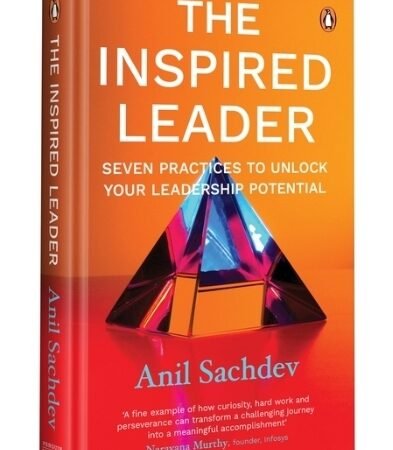
The Inspired Leader by Anil Sachdev: Seven Key Practices, Published by Penguin Business (Penguin Random House India), 2026 · 210 pages · Foreword by Nitin Nohria, former Dean of Harvard Business School
In a world that keeps telling us to look outward — to role models, to gurus, to the next viral leadership thread — what if the answers we keep chasing already live inside us? That is the quietly radical premise of The Inspired Leader by Anil Sachdev, a 2026 release from Penguin Business that has become one of the most talked-about leadership books in India this year, going into its third reprint within two months of publication.
This is not another book about climbing faster, managing harder, or optimising your way to the corner office. It is a book about the inner work that comes before the outer results — and about a simple, unsettling idea: leadership does not begin with leading others. It begins with leading yourself.
Why “The Inspired Leader by Anil Sachdev” Arrives at the Right Time
We are living through what many writers now call a BANI world — Brittle, Anxious, Nonlinear, and Incomprehensible. Trust in traditional authority, from politicians to CEOs, is falling. Attention spans are fragmenting under the weight of always-on digital life. And into that vacuum has rushed a flood of leadership content that promises transformation through frameworks, hacks, and quick fixes.
Anil Sachdev’s book takes the opposite route. Rather than offering a shortcut, it argues that sustainable leadership is sourced from within — from purpose, character, compassion, and deliberate self-awareness. As one reviewer put it, inspiration has to come from inside; without deep self-awareness, leadership skills simply do not stick. In an era obsessed with external signals of success, that is a genuinely counter-cultural message.
Who Is Anil Sachdev? The Man Behind the Book
To understand the book, it helps to understand the author, because the two are inseparable.
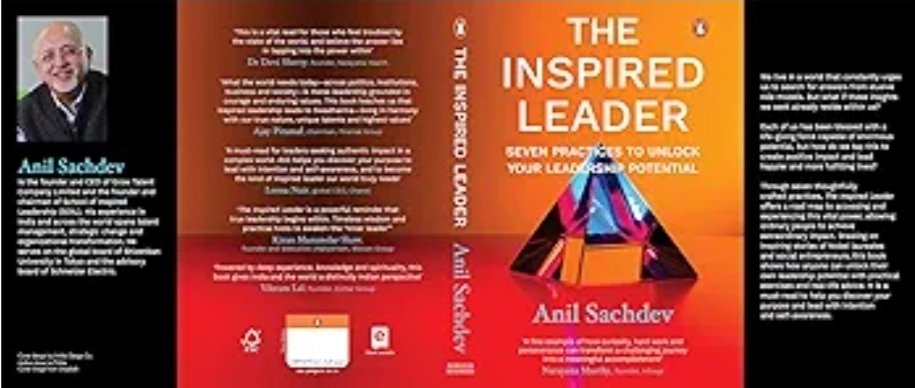
Anil Sachdev has spent roughly five decades in Indian industry and education. He began his career at Tata Motors in 1975, spent more than two decades at the Eicher Group — heading HR and operations and sitting on its board — before founding Eicher Consultancy Services (1991) and Grow Talent (2001). In 2008, he co-founded the School of Inspired Leadership (SOIL) in Gurgaon, an institution co-created with 32 companies around five pillars: compassion, diversity, ethics, mindfulness, and sustainability.
He has been adjunct faculty at the Indian School of Business, Indiana University’s Kelley School of Business, and CEDEP/INSEAD, and he is a Trustee of the Chinmaya Mission. Notably, he declined the offer to become Director of both IIM Ahmedabad and IIM Bangalore, choosing instead to keep building — a decision that says much about his conviction that leadership is a craft to be lived, not just taught.
He wrote his life’s mission statement at nineteen. The Inspired Leader is, in effect, the distillation of everything he has learned in the decades since.
The Two Lies That Keep Us From Leading
Sachdev opens the book with a deliberately provocative choice of words. He does not call them myths. He calls them lies, and he asks the reader to banish two of them:
- That leaders are born, not made. This is the quiet excuse so many of us use to opt out of our own potential. If leadership is a genetic lottery, then most of us are off the hook. Sachdev insists the opposite: the capacity is in each of us, waiting to be found and built.
- That leadership is about leading others. This is the first lie of leadership, and arguably the most damaging. True leadership, he argues, is sourced from within — it is about serving a larger purpose and being true to your own gifts and values before you ever try to direct another person.
Reframing leadership as an inside-out journey changes everything that follows. Once you accept that the work starts with you, the seven practices stop looking like management techniques and start looking like disciplines for living.
The Seven Practices at the Heart of the Book
The middle of the book is built around seven practices — one for each dimension of the inner work. Together they form an arc from self-knowledge to meaningful action. (The author’s own summary of the chapters uses these seven headings, and they map onto the seven “unlock your leadership potential” dimensions.)
Practice 1: Rewriting the Story You Tell Yourself
The first practice is about the way you tell the story of your life to yourself — and how you might script a new one. We all carry an internal narrative, and often it is a deficit story: what we lack, what we missed, what we cannot do. Sachdev’s invitation is to consciously reframe that dialogue toward abundance, because the story we tell ourselves quietly determines what we believe we are capable of. Change the narrative and you change the reality it produces.
Practice 2: Discovering Your Gifts
The second practice is about the magic of discovering your gifts by learning from your happiest best. The phrase is doing real work here. Rather than starting from a list of weaknesses to be fixed, Sachdev points readers toward the moments when they were at their most alive and effective — and asks what strengths made those moments possible. This is the SOAR mindset (Strengths, Opportunities, Aspirations, Results) rather than the familiar SWOT.
Practice 3: The Power of Conscious Learning
The third practice is about invoking the child in you — reclaiming the curiosity and openness that most adults trade away for the comfort of expertise. Conscious learning means staying a student deliberately, long after the formal education ends, and treating every experience as material to learn from.
Practice 4: Thinking With the Whole Mind
The fourth practice concerns sourcing the capacity to think with the whole mind. In a world that rewards fast, narrow, reactive thinking, Sachdev makes the case for a fuller kind of cognition — one that draws on intuition, emotion, and reflection alongside analysis, and that holds up under pressure. It is thinking as a practice, not just a reflex.
Practice 5: The Joy of Building Trusting Relationships
The fifth practice is the joy of building trusting relationships. Trust, Sachdev argues, is not a soft extra — it is the operating system of any group that wants to do hard things. He breaks it down to three ingredients: competence, credibility, and fairness. Get those right, consistently, and trust compounds; break them once, and it can take years to rebuild.
Practice 6: Building the Capacity to Act
The sixth practice is about the capacity to act — bridging the gap between knowing and doing. Most of us know more than we do; the distance between insight and action is where potential quietly dies. This practice is about closing that “knowing–doing” gap with intention and courage, so that reflection does not become an excuse for inaction.
Practice 7: Defining Your Purpose and Values
The seventh practice is about deriving strength from defining your purpose and values. Purpose is presented not as a nice-to-have but as the deepest source of commitment and endurance. When your daily effort is aligned with a cause larger than yourself, work stops being a job and becomes, in Sachdev’s memorable phrase, “love made visible.”
Awakening the Inner Leader: The Final Chapter
The book closes with an honest acknowledgement of the hardest obstacle of all: ourselves. Sachdev draws on the well-known idea of immunity to change — the way our own hidden commitments and fears quietly sabotage the very goals we say we want. His remedy is to invoke the “inner witness”: to observe our own contradictory thoughts without judgement, so that hidden mental conditioning loses its grip and we can finally step into our potential.
The message of the closing chapter is hopeful and demanding at once: you do not need to become someone else. You need to awaken the leader who already resides within.
The Philosophy Behind the Practices: Where East Meets West
One of the things that sets The Inspired Leader apart is its intellectual range. Sachdev weaves together Indian and Eastern philosophy with Western management thinking. The book moves from Patanjali’s five sheaths of the human being, Vedanta, and the Japanese concept of ikigai, to Western frameworks such as Appreciative Inquiry and Kegan’s Immunity to Change map.
It also draws on lived stories with remarkable emotional force. The most cited is the account of Taj Hotel staff during the 2008 Mumbai terror attacks — how their love for the organisation gave them the courage to act selflessly under fire. Sachdev’s takeaway is striking: the opposite of fear is not courage but love. It is a book that treats philosophy and management as two dialects of the same conversation about how to be human at work.
What Tech Leaders Can Take Away
For a technology audience, the book has a sharper edge than it might first appear. Sachdev speaks directly to the anxiety and disconnection of a “rapidly changing, technology-driven world,” and he is refreshingly clear-eyed about the cost of our digital habits. He calls for a daily “date with yourself” in silence — stepping away from the constant stimulation of devices to reconnect with your inner source of being. For founders and engineers who live inside notifications, that is not a luxury; it is maintenance.
He also offers a playful but pointed reframe: the two “AIs” that matter more than artificial intelligence are Appreciative Inquiry and the shift from Aspiration to Inspiration. In other words, the technologies that will define the next decade are only as good as the humans who lead them — and those humans still need self-awareness, empathy, and judgement that no model can supply.
The practices scale neatly to modern teams. When asked how to develop empathy in an organisation, Sachdev did not reach for a metric. He recommended “circles of storytelling” — creating space for people to share the turning points of their lives, as executives at Tata Steel did during a succession-planning offsite after working together for 25 years. It is a reminder that the highest-performing teams are usually the most human ones.
Who Should Read The Inspired Leader
The book is pitched as relevant whether you lead in the boardroom, the classroom, or the community. In practice, it will land hardest with:
- Founders and senior leaders who have achieved external success and are quietly asking what it was for.
- HR and people leaders looking for a values-driven approach to culture, trust, and empathy.
- Mid-career professionals navigating transitions or burnout.
- MBA students and early managers who want a foundation before the tactics.
- Coaches and educators who need a coherent philosophy to anchor their practice.
If you are looking for a step-by-step playbook with templates and matrices, look elsewhere. This is a book of practices and questions, not procedures.
Strengths and a Balanced View
The Inspired Leader’s greatest strength is its authenticity. As one reader observed, it is a case of “WYSIWYG” — what you see is what you get — because Sachdev has actually lived these practices rather than merely theorising about them. The blend of lived experience, spiritual depth, and practical frameworks gives it a credibility that purely academic leadership books often lack.
Its approach is also invitational rather than prescriptive: it asks you to reflect and discover rather than to comply. That is a strength for engaged readers, though it does mean the book demands something of you — it will not do the inner work on your behalf. Readers who prefer hard data, case studies with measurable outcomes, or a more sceptical, empirical treatment of “purpose” may find the tone more aspirational than analytical. That is a matter of taste, not of quality; the book knows exactly what it is.
The Inspired Leader by Anil Sachdev: Key Takeaways
- Leadership begins with leading yourself — body, breath, emotions, and intellect — before it ever touches other people.
- The two lies to unlearn: leaders are born, and leadership means leading others.
- The seven practices run from self-knowledge (stories, gifts, learning, thinking) to connection and action (trust, acting, purpose and values).
- Trust is built on competence, credibility, and fairness — and rebuilt slowly.
- Purpose is the deepest source of commitment; work aligned with it becomes “love made visible.”
- Overcoming immunity to change requires an “inner witness” — observing your own mind without judgement.
- You are enough, as you are. Take one step from where you stand, and the path reveals itself.
The Verdict
The Inspired Leader by Anil Sachdev belongs to the small category of books that stay with you for a lifetime rather than a few hours. It is spiritually anchored, humanistically grounded, and rich with practical wisdom — a manual for leadership development rather than a manual for management. In a BANI world hungry for genuine, grounded leadership, it offers something rare: not a formula, but a way of being.
Its third reprint of The Inspired Leader by Anil Sachdev in two months suggests readers are ready for exactly that message. Whether you lead a startup, a team, a classroom, or simply your own life, the book’s closing invitation is worth accepting: the leader you are looking for is already within you.
Book Details
| Title | The Inspired Leader: The Practices for Manifesting Our True Potential |
| Subtitle | A Guide to Purpose-driven Leadership |
| Author | Anil Sachdev |
| Foreword by | Nitin Nohria, former Dean, Harvard Business School |
| Publisher | Penguin Business (Penguin Random House India) |
| Published | May 2026 |
| Pages | 210 |
| Format | Hardback |
| ISBN | 9780143478485 |
| MRP | ₹599 |
Sources: Penguin Random House India; the author’s published summaries of the book’s chapters; SOIL Institute of Management; a Shizenkan University forum report on the book’s themes; and reader reviews from LinkedIn.