
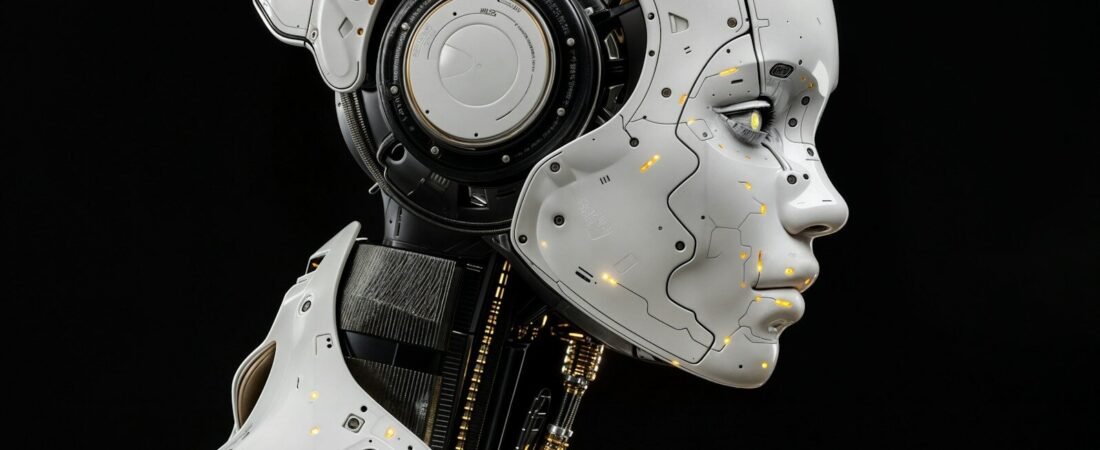
RoboParty unveiled RP1, a bipedal humanoid, at IROS 2026 in Pittsburgh, calling it the “world’s first high-performance full-stack open-source bipedal humanoid robot”. The Shanghai startup says the robot recovers its balance when kicked. It delivers up to 160 N·m of joint torque and runs on an open development foundation called PartyOS. The RoboParty RP1 pitch is simple: humanoid robotics should be open, not owned.
That is a real position in a field that badly needs one. It is also a claim that meets some awkward comparisons.
What RoboParty RP1 actually is
The robot, also called ROBOTO 01, is the successor to ROBOTO ORIGIN — a prototype RoboParty developed in about 120 days and open-sourced in January 2026. RP1 is the polished version, shown publicly for the first time at IROS.
Its headline technical claim is peak joint torque of up to 160 N·m, from in-house “Romomo” actuator modules and a real-time motion-control system. The training stack includes UFO, a framework that learns humanoid motor skills through unsupervised reinforcement learning — meaning the robot is not following pre-scripted motion trajectories.
The demonstration made a point. Visitors pushed and kicked the robot, which then had to recover. Balance recovery under disturbance is a standard test of whether a humanoid’s control stack actually works, and RoboParty put it on the show floor.
The “world’s first” claim, tested
The superlative in the release is where scrutiny belongs. RoboParty calls RP1 the “world’s first high-performance full-stack open-source bipedal humanoid robot”.
Several peers complicate that. Berkeley Humanoid Lite, from UC Berkeley, publishes hardware, firmware, simulation and training code, uses 3D-printed gearboxes and costs under $5,000 in parts — with a research paper behind it. Fourier’s N1 publishes CAD, a bill of materials and software. Stanford’s ToddlerBot released hardware, firmware and learning code too.
The qualifiers do the work. RP1 may be the first to combine “high-performance”, “bipedal” and “full-stack” in one open package. But “world’s first” reads as broader than the evidence supports, and the company has not published a comparison.
The company behind it
RoboParty is young. Yi Huang, described as a 21-year-old early graduate, founded it in February 2025 and leads it. Its team comes from Tsinghua’s Yao Class, Peking University’s Zhi Class, Harbin Institute of Technology, Stanford, Carnegie Mellon and Zhejiang University.
The backing is serious for a company this new. It raised a US$10 million seed round in November 2025, co-led by Matrix Partners China and Xiaomi. The company says its developer community has passed 5,000 people.
Its plan is staged. It has positioned itself as an “embodied infrastructure” builder — the idea being that shared, reproducible humanoid foundations, not proprietary robots, will accelerate the field. ROBOTO ORIGIN, at 1.25 metres and 34 kilograms, was the proof of concept.
The scrutiny: open source or “GitHub theater”?
Here is the part the release does not mention. An independent technical audit of ROBOTO ORIGIN, published in March 2026, found the open-source promise only partly kept.
The audit noted that the repositories had no tagged releases, so there is no stable version to build against. It found the USB-to-CAN gateway’s firmware is Linux-only but its source is not exposed. Motor interface specifications — torque ratings, encoder resolution, protocols — are not listed. Safety-brake logic was unclear.
It also observed that most of the project’s GitHub stars sit on the higher-level ROS2 and reinforcement-learning wrapper, while the hardware repository attracted far fewer. The conclusion was blunt: without published firmware interfaces and reproducible binaries, “full-stack open source” is only partly delivered.
That matters because the RoboParty RP1 pitch rests on open source being its entire differentiator. If the firmware and interfaces stay closed, the claim is positioning, not product.
Why it lands at IROS now
The timing is deliberate. IROS 2026 drew roughly 7,000 attendees to Pittsburgh, and the exhibition floor was dominated by humanoids and five-finger hands. Chinese robotics firms were out in force — Astribot with its T1, GENISOM AI, Unitree and Sharpa among them.
In that crowd, open source is a way to stand out. Unitree sells volume with a closed body and an open SDK. RoboParty is trying the opposite: give away the whole stack and win the developer ecosystem. It is a bet on the K-Scale idea, in a market where K-Scale itself ran out of money.
What to watch
Three markers will show whether RP1 is substance or staging.
First, the October drop. RoboParty has promised to detail its open-source roadmap in October. Watch whether the firmware, interfaces and tagged releases that were missing before actually appear.
Second, the torque claim. 160 N·m is a specific, testable number. Independent measurement would settle it.
Third, the build. If developers can genuinely reproduce RP1 from the files, the “embodied infrastructure” thesis holds. If they cannot, it is a demo.
RoboParty is making the most interesting bet in humanoid robotics: that openness, not ownership, is the winning strategy. The question is whether it will open the parts that matter.
Editor’s Note
Sources: RoboParty‘s release of 3 October 2026 and its GitHub repositories (roboto_origin and its sub-repositories). Company background, the US$10 million seed round and ROBOTO ORIGIN’s specifications are from robotics trade coverage of the January 2026 open-source launch.
The independent audit of ROBOTO ORIGIN’s repositories is from CyberNative’s March 2026 analysis. The open-source humanoid landscape is from Berkeley Humanoid Lite’s arXiv paper and repository, K-Scale Labs’ repositories, Fourier and Unitree documentation, and Humanoid Observer’s field survey. IROS 2026 context is from the conference’s own materials and robotics-press coverage. The RP1 specifications, the “world’s first” claim and the mass-production plans are as stated by RoboParty. TechRecast has not independently verified them, and the open-source roadmap had not been published at the time of writing.