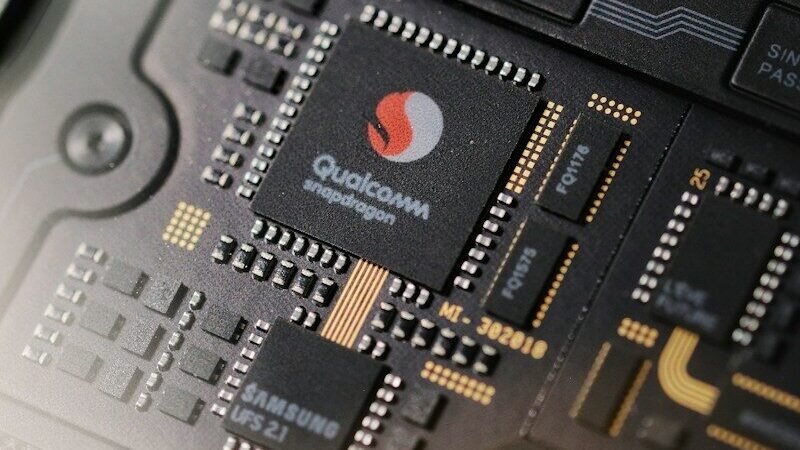
On 8 September, Qualcomm announced a “multi-generation collaboration” with Amazon to build customised silicon for AI data centres and optical connectivity up to 1.6T. The release ran to a few hundred words.
It did not mention the most important number. The SEC filing did.
What the release said — and didn’t
The announcement was light on specifics. Qualcomm would work with Amazon on custom silicon for AI inference and on optical connectivity, using its SerDes and optical DSP technologies. Qualcomm would also use AWS infrastructure, including Amazon Bedrock, for chip-design workloads.
That is roughly the whole of it. No deal value, volumes, product names or timeline. The Register’s headline called it “more buzzwords than compute,” and noted that chief executive Cristiano Amon’s quote told readers “absolutely nothing about the nature of the deal.”
In a normal vendor release, that vagueness would be the story. Here, it was a tell — because the filing said something else.
What the filing revealed
Reuters reported that Amazon could buy up to $60 billion of Qualcomm’s AI data-centre chips and related products under the partnership. The mechanism was in Qualcomm’s Form 8-K: Qualcomm issued Amazon an equity warrant to buy up to 25 million shares at $161.26 each.
The warrant is performance-based. It vests in stages tied to Amazon’s actual purchases, not to the announcement. An initial 3.75 million shares vested immediately against Amazon’s opening commitments. Unlocking the full haul would require Amazon to spend up to $60 billion on Qualcomm’s chips, networking gear and manufacturing services through September 2036.
That structure reframes the announcement. This is not primarily a technology collaboration. It is a decade-long supply agreement, with Qualcomm using its own equity to bind its largest new customer to volume commitments. Investors read it that way: Qualcomm shares rose more than 5% on the news.
Why Qualcomm needed this win
The deal matters because of what Qualcomm is trying to become. The company is running a multi-year pivot beyond smartphones into data-centre silicon, targeting more than $15 billion in annual data-centre revenue by fiscal 2029.
Its Dragonfly portfolio spans a CPU, an inference accelerator line, and a memory architecture called High Bandwidth Compute that 3D-stacks compute with LPDDR DRAM rather than placing memory on a separate substrate. Qualcomm claims HBC delivers several times better performance-per-watt than HBM-based designs — a vendor claim, not an independently measured one.
The capability was largely bought. Alphawave Semi, acquired for about $2.4 billion, brought SerDes, optical DSP, custom silicon and chiplet IP. Ventana Micro added RISC-V CPUs. Modular added open-source AI software. The custom-silicon business is the piece that lets Qualcomm sell to hyperscalers who want their own designs rather than merchant parts.
Before Amazon, the named wins were Meta, for the Dragonfly C1000 CPU, Microsoft, for HBC accelerators in Azure, and HUMAIN in Saudi Arabia. AWS is the first Western hyperscaler to sign up for Qualcomm data-centre silicon. That is the credibility the company lacked a year ago.
What AWS gets
Amazon is not short of silicon. It designs Graviton for CPUs, Trainium for training and inference, Inferentia for inference, and Nitro for virtualisation. Trainium3 is its first 3nm AI chip. Amazon’s chip business is now on an annual revenue run rate above $20 billion, growing triple-digit percentages.
So the Qualcomm deal is additive, not a replacement. It gives AWS another custom-silicon path for inference, the workload where energy cost per token drives the economics. And it gives AWS a second source in optical connectivity — an area where it already buys from Marvell and Broadcom. Analysts were quick to note that the networking piece should not be read as Amazon dropping its existing suppliers.
The real battleground: optics
The most consequential part of the deal is the least discussed. High-speed optical interconnects have become a genuine supply-chain bottleneck for AI infrastructure. Compute now scales from a rack of dozens of accelerators to hundreds or thousands spanning racks.
The race to 1.6T is well under way. Marvell has expanded its 1.6T optical DSP portfolio and introduced a 1.6T ZR/ZR+ pluggable with a 2nm coherent DSP. Broadcom launched Taurus, which it calls the industry’s first 400G/lane optical DSP for 1.6T transceivers. LightCounting expects more than 100 million units of 1.6T and 3.2T transceivers to ship over five years, with close to half using 400G optics.
Qualcomm’s contribution is the SerDes and optical DSP technology it bought with Alphawave. The Amazon deal is its first commercial validation at hyperscale. That is what turns a $2.4 billion acquisition into a revenue-generating asset — and it is the part of the announcement that will matter longest.
What to scrutinise
Three things deserve a second look.
First, the vagueness is not an accident. “Customized silicon” could mean fully custom chips, chiplets, or tweaked versions of Qualcomm’s existing accelerators. Nobody outside the two companies knows which, and neither has said.
Second, the performance claims are Qualcomm’s own. The 4–8x performance-per-watt figure for HBC is stated against HBM-based designs, measured on Qualcomm’s terms. It is a claim to test, not a benchmark to trust.
Third, the warrant is a bet, not a guarantee. Its value depends on Amazon actually buying tens of billions of dollars of hardware over a decade. If Amazon’s inference strategy shifts, so does the payout.
What to watch
Three markers will show whether this deal delivers.
First, a named product. When Qualcomm and AWS disclose what silicon they are actually building, and when it ships, the collaboration becomes real.
Second, the optical ramp. If Qualcomm’s SerDes and DSP win sockets in AWS’s 1.6T build-out, the Alphawave acquisition will have paid for itself. If Marvell and Broadcom hold the sockets, it will not.
Third, whether the $15 billion data-centre target holds. Qualcomm has turned ambition into a signed agreement with a top-three hyperscaler. Revenue is what comes next.
The press release gave readers a collaboration. The filing gave them a contract. In AI infrastructure, the contract is where the story lives.

Editor’s Note
Sources: Qualcomm’s collaboration release of 8 September 2026, Qualcomm’s SEC Form 8-K and the accompanying equity warrant, and Reuters reporting on the deal. Additional context and independent analysis are from TechTarget, The Register, HotHardware, The Decoder, RCR Tech, Nand Research, Futurum Group and Data Center Intelligence.
Qualcomm product and roadmap facts are from its own Investor Day and product releases, including the AI200/AI250 and Dragonfly portfolio announcements and the Alphawave Semi acquisition release. AWS silicon facts are from AWS and About Amazon documentation, plus TechCrunch reporting on the Trainium programme. Optical interconnect context is from Marvell, Broadcom and LightCounting. The $60 billion figure, the warrant structure and the performance-per-watt claims are as disclosed by the companies; TechRecast has not independently verified them.