
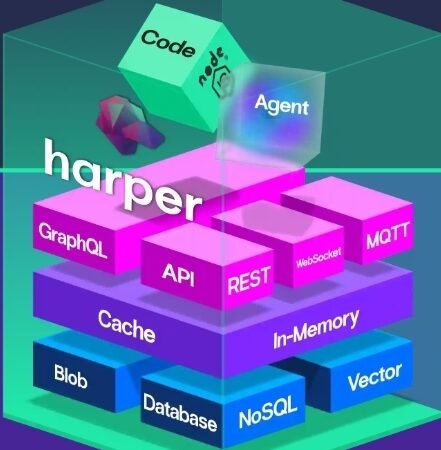
Harper is using its latest release Harper 5.2 to make a broader argument about application architecture: keeping code, data, caching and messaging together can reduce latency and operational complexity. But its own benchmark also shows where a conventional serverless architecture still has the advantage.
Modern application architecture has increasingly become a story of specialization.
An application may run on a serverless platform, store data in a managed database, use a separate Redis layer for caching, depend on another service for real-time messaging and add yet another system for scheduled jobs.
Each component solves a legitimate problem.
The trade-off is that the application must coordinate all of them.
Harper is now challenging that model.
With version 5.2, the database and application platform is strengthening its argument for what it calls a single-runtime architecture. The approach keeps application code and data in the same runtime while bringing capabilities such as caching, messaging, scheduling and other infrastructure functions closer together.
The company says this can reduce network hops, improve latency and allow more traffic to be handled by the same hardware.
Its argument is supported by a benchmark against a Vercel-based stack. Harper reports significant performance advantages for live, personalized-data workloads.
But the benchmark also exposes an important limitation: there is no universal winner.
Vercel’s serverless architecture performs better under some high-concurrency workloads, particularly when elastic scaling and cacheable content matter more than in-process access to live data.
That makes Harper 5.2 interesting for a reason that goes beyond the release itself.
It is part of a larger debate over whether modern application stacks have become unnecessarily fragmented.
The Problem With the Multi-System Stack
A conventional modern web application can involve several independent infrastructure layers.
Application code may run in a serverless function. The database may sit elsewhere. A cache can sit between them. Real-time updates may require another service. Background processing may use a separate job system.
That architecture provides flexibility.
It also introduces boundaries.
Every boundary can require a network request, serialization, authentication, monitoring, failure handling and another operational dependency.
For applications that mostly serve static or highly cacheable content, those costs can be acceptable.
They become more significant when every request requires fresh, personalized information.
Consider an application displaying a customer’s current account status, personalized recommendations, inventory availability or entitlement information.
The application needs fresh data.
If the application and database are separated, retrieving that data requires communication between the two systems.
Harper’s architectural proposition is simple: what if the application could access that data directly inside the same runtime?
The result is less about eliminating databases than about eliminating unnecessary distance between application logic and the data it needs.
Harper’s Single-Runtime Bet
Harper positions its platform as a unified runtime for applications, data, caching and messaging.
Its architecture keeps data and application code in the same process rather than requiring every personalized read to cross a network boundary. Harper describes the access pattern as an in-process function call against data held close to the application.
That architectural choice is particularly relevant to applications where data freshness matters.
A cache can reduce database traffic, but it can also introduce another question: how fresh is the cached value?
A distributed cache can also become another system that developers must configure, monitor and troubleshoot.
Harper’s argument is that co-location can address both latency and complexity.
The company is not claiming that distributed architectures are inherently wrong. Instead, it is arguing that the industry may have accepted multiple infrastructure layers as the default when some workloads could benefit from collapsing those layers.
That is a significant architectural proposition.
What Harper 5.2 Actually Changes
Harper 5.2 strengthens that proposition with several performance and operational changes.
The most prominent is a new record cache.
According to Harper, repeated reads can now bypass the storage layer while still returning the current record. In its internal testing, warm reads were five to eight times faster. Transactional reads improved by about five times, while the tested vector-search workload improved by approximately 2.6 times.
There is an important qualification.
Cold reads do not become faster.
The first request still needs to retrieve the record from storage and populate the cache. The benefit appears when applications repeatedly access the same data.
That makes the feature particularly relevant to workloads involving product catalogs, personalized pages, sessions, permissions and other information that is read frequently but changes comparatively infrequently.
Write isolation is another major change
Harper 5.2 also changes how database commits use worker resources.
In earlier versions, database commits competed for a shared worker pool with unrelated asynchronous operations. Under sustained write pressure, that could increase latency for other work.
Version 5.2 gives each database its own commit path.
Harper says raw commit throughput remains approximately the same. The improvement is isolation rather than simply more write capacity.
In its test, median latency for unrelated asynchronous work fell from 15.1 milliseconds to 0.12 milliseconds. The p99 figure fell from 223.7 milliseconds to 2.6 milliseconds. On a strained 46GB database, the reported worst p99 fell from 51 milliseconds to 3.4 milliseconds.
That distinction matters.
For production systems, average latency is only part of the story. Tail latency can determine whether an application feels reliable during traffic spikes or heavy write activity.
The SQL engine has also changed
Harper 5.2 makes a new SQL engine the default.
The engine can plan supported query types directly against Harper’s indexes instead of routing every query through a generic execution path.
In Harper’s benchmark, retrieving 10 records by primary key from a 40,000-record table fell from 133.6 milliseconds to 1.65 milliseconds.
Other tested query types also showed substantial reductions. A medium join dropped from 175.8 milliseconds to 7.30 milliseconds, while an ORDER BY with LIMIT fell from 149.6 milliseconds to 2.76 milliseconds.
Again, these are Harper’s own measurements, rather than independent third-party benchmarks.
The Vercel Comparison
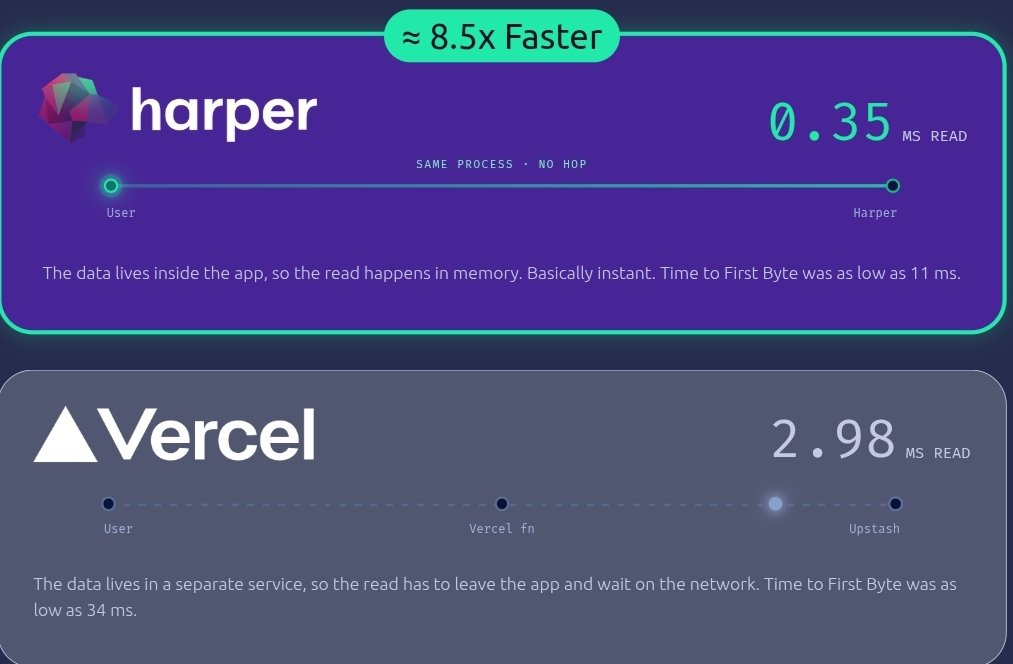
The most interesting part of Harper’s architectural argument is its comparison with a Vercel-based application stack.
The benchmark builds the same emoji product-catalog application in two ways.
The Harper version keeps data, compute and messaging together.
The comparison stack uses Vercel Functions, Neon Postgres, Upstash Redis and Ably for real-time capabilities. The applications share a common DataSource contract, with the architecture being the major variable under test.
Harper reports in-process data access at roughly 0.4 milliseconds compared with approximately 3 milliseconds for the network path to a separate data tier.
That difference may look small in isolation.
It becomes more consequential when a page requires several personalized data operations.
A single network hop may be inexpensive. A sequence of dependent calls can turn those small costs into a significant portion of the request’s total latency.
This is where Harper’s architecture has its strongest argument.
The Benchmark Does Not Declare Harper the Universal Winner
This is also where the benchmark requires careful reading.
Harper tested eight scenarios across two US regions, running 474 load tests over three trials.
The results favored Harper for live, personalized-data paths, including single reads, live-value injection, server-side streaming, write-to-read freshness and read fan-out under normal load.
Harper reports advantages of several times in some scenarios, reaching approximately 14 times in the largest reported difference.
But Vercel won in other situations.
Under high, sustained fan-out, Vercel’s serverless autoscaling outperformed Harper’s single free node. Vercel also had an advantage with cacheable content and broadcast-oriented real-time workloads.
That is not a minor footnote.
It demonstrates the central trade-off between the two architectures.
A co-located runtime can make individual data operations extremely cheap.
A serverless architecture can add capacity dynamically when concurrency rises sharply.
Those are different optimization targets.
The Most Important Benchmark Caveat
There is another qualification that developers and technology leaders should not overlook.
The benchmark used a warm, in-memory dataset.
That favors an architecture designed around local data access.
If a production workload has a working set larger than available memory, the performance characteristics can change.
More importantly, the benchmark was conducted before Harper 5.2 was released.
It therefore does not demonstrate that the new 5.2 record cache or SQL engine produces the same performance advantage in the Harper-versus-Vercel comparison.
Independent technology publication InfoQ specifically notes that the benchmark predates version 5.2 and has not been rerun.
That distinction should remain front and center.
Harper 5.2 has its own performance measurements.
The Harper-versus-Vercel comparison is a separate benchmark.
They should not be combined into one performance claim.
Why Personalization Is the Key Workload
The architectural argument becomes clearer when looking at personalization.
A generic product page can often be cached.
A personalized product page cannot necessarily be treated the same way.
The application may need to know:
- who the customer is;
- what products they are entitled to see;
- what inventory is available;
- what their previous interactions were;
- what pricing applies to them;
- what recommendations should appear;
- and what has changed since their last request.
The more of those decisions require current data, the less useful a generic edge-cache strategy becomes.
That is where the distance between compute and data matters.
Harper’s architecture attempts to make the distance effectively local.
The company’s broader personalization work frames the problem around two forms of distance: the distance between computation and the user, and the distance between computation and fresh data.
That is a useful way to understand the architecture.
Performance is not simply about having a faster database.
It is about reducing the number of expensive boundaries a request must cross.
Where the Multi-System Approach Still Wins
The multi-system model exists for good reasons.
Separating application compute from databases and infrastructure services can provide independent scaling.
A serverless platform can scale application capacity without requiring the database to scale at the same rate.
A dedicated cache can absorb huge volumes of repeated requests.
A specialized messaging platform can handle real-time fan-out at a scale that an individual application node may not.
Different services can also be replaced independently.
That flexibility can be extremely valuable for large engineering organizations.
Harper’s own benchmark illustrates the point.
When concurrency increases sharply, the Vercel architecture can exploit serverless autoscaling, while the tested Harper free node eventually reaches a throughput ceiling.
So the question is not whether distributed systems are obsolete.
They are not.
The question is whether every application needs all those boundaries.
Harper 5.2 Goes Beyond Performance
The 5.2 release also expands the argument from performance into operational consolidation.
Harper says applications can use built-in scheduling for recurring tasks such as synchronization, reporting, embedding refreshes and cleanup.
It also provides capabilities around backup and restore, application routing and web application firewall functionality.
For AI applications, Harper says model execution, agent loops, scheduled workloads and retrieval can operate closer to application data. The platform supports model backends including OpenAI, Anthropic, Amazon Bedrock and Ollama.
That matters because AI applications are increasingly creating their own infrastructure stacks.
A typical AI application may involve:
Application + database + vector database + cache + model provider + queue + scheduler + authentication + observability + secrets management.
The technology itself is not necessarily the problem.
The integration burden is.
Every additional service creates another API, credential, failure mode and operational responsibility.
Harper’s proposition is that more of those responsibilities can be absorbed by the application runtime.
A Different Direction From the Broader Database Trend
There is an interesting architectural contrast emerging in the database market.
Some platforms are moving toward greater separation between compute and storage.
Harper is moving in almost the opposite direction.
Its philosophy is to bring application logic and data closer together.
Neither approach is universally superior.
Separation can improve flexibility, independent scaling and resource utilization.
Co-location can reduce network overhead and simplify data-intensive application paths.
The interesting question is therefore becoming less about whether one architecture replaces the other.
It is about which workload characteristics justify which architecture.
What This Means for AI Applications
The debate becomes particularly relevant as AI applications become more stateful.
An AI agent may need access to customer information, product data, permissions, conversation history, tools, schedules and vector-search results during a single interaction.
If every operation crosses a different infrastructure boundary, latency and operational complexity can accumulate quickly.
Harper‘s approach is to place more of that functionality inside the same runtime.
Version 5.2 also improves repeated vector-search performance in Harper’s testing and allows semantic retrieval to incorporate synchronous record-level access filters during traversal.
That could be useful for enterprise AI systems where semantic relevance alone is insufficient.
A support agent, for example, may need to retrieve relevant customer records while respecting account-level permissions.
An internal enterprise assistant may need to search documents while enforcing employee access rights.
A commerce agent may need to combine semantic similarity with regional or customer-specific rules.
Bringing those operations closer to the application can reduce the amount of integration code required.
But it does not eliminate the need for careful architecture.
Security, isolation, observability, disaster recovery, governance and scaling remain important regardless of where the components run.
The Cost Question
There is also a potentially important economic argument.
If repeated reads require less database work and supported queries become substantially faster, the same hardware may handle more traffic.
Harper explicitly positions 5.2 as a way to improve throughput per node and reduce infrastructure requirements for workloads that benefit from caching and optimized indexed queries.
There is another possible saving.
If scheduling, caching, messaging, routing and other responsibilities can be handled inside the same platform, organizations may need fewer external services.
But this should not be interpreted as automatic cost reduction.
A single platform may reduce the number of invoices and integrations while increasing dependency on one technology.
The economic calculation must therefore include:
- infrastructure consumption;
- engineering effort;
- operational staffing;
- observability;
- vendor or platform dependency;
- scaling requirements;
- disaster recovery;
- migration costs;
- and the cost of future architectural changes.
Fewer components do not automatically mean lower total cost.
They can, however, mean fewer integration points.
That distinction is important.
The Architectural Trade-Off
Harper’s proposition can be reduced to a simple architectural choice.
The multi-system approach optimizes for separation and independent scalability.
The single-runtime approach optimizes for locality and operational simplicity.
Neither eliminates the fundamental trade-off.
A high-concurrency application serving mostly cacheable content may benefit enormously from an elastic serverless architecture and a powerful CDN.
An application that constantly assembles personalized information from live state may benefit more from keeping computation close to that state.
The right question for an architecture team is therefore not:
“Which platform is faster?”
It is:
“Where is the dominant cost in our workload?”
If the dominant cost is network communication between application and data systems, co-location becomes attractive.
If the dominant problem is unpredictable concurrency, elastic compute becomes more valuable.
If the dominant problem is cache invalidation, data freshness may matter more than raw throughput.
If the dominant problem is operational complexity, reducing the number of infrastructure boundaries can have significant value.
What Harper 5.2 Really Represents
Harper 5.2 is therefore more interesting as an architectural statement than as another database version.
The record cache improves repeated reads.
The isolated commit path improves behavior under write pressure.
The new SQL engine reduces the cost of supported indexed queries.
The platform is also adding capabilities that can reduce reliance on separate infrastructure services.
Together, those changes reinforce Harper’s larger proposition:
Applications do not necessarily need to be assembled from a collection of specialized systems to achieve scale and performance.
That does not mean the multi-system stack is dead.
It means the pendulum may be moving toward a more deliberate choice between composition and consolidation.
For some workloads, the network hop between application and data is an unnecessary tax.
For others, the ability to independently scale and replace infrastructure components is worth paying that tax.
The TechRecast Take
The most important lesson from Harper 5.2 is not that Harper is faster than Vercel.
The benchmark does not establish that as a universal conclusion.
It shows something more useful.
Architecture determines where performance comes from.
Harper gets much of its advantage by removing distance between application logic and data.
Vercel gets much of its advantage from elastic compute and edge-oriented delivery.
When an application needs fresh, personalized data on every request, locality can be enormously valuable.
When the workload is dominated by cacheable content or sudden concurrency spikes, elasticity can be more important.
Harper’s 5.2 release makes the single-runtime argument more credible by improving caching, query execution and workload isolation.
But the real test will come from production workloads outside Harper’s own benchmark environment.
The next meaningful step would be an independently reproducible comparison using Harper 5.2 against equivalent multi-system architectures, across cold and warm datasets, different working-set sizes, sustained concurrency, burst traffic, regional distribution and complete cost-per-request measurements.
Until then, the strongest conclusion is not that Harper has defeated the modern application stack.
It is that Harper has put an important architectural question back on the table: how many systems does an application really need?
And as applications become increasingly personalized, real-time and AI-driven, that question is becoming harder for architecture teams to ignore.