
Fibocom’s India IoT push: NavIC modules, smart meters — and a China-vendor question
Fibocom, a Shenzhen-based manufacturer of wireless communication modules listed in both Shenzhen and Hong Kong, used India Mobile Congress 2026 to present a portfolio aimed at India’s connected-device market: 5G fixed-wireless-access modules and devices, smart-metering connectivity, vehicle and asset trackers, satellite positioning and edge AI.
It is worth being clear about what this is. Fibocom did not launch a product, sign a disclosed deal or announce committed volumes. It showed a catalogue and named local partners. The substance — and the interesting questions — sit underneath the showcase.
The Fibocom India IoT strategy, as presented, rests on two things: localisation of the products, and partnerships with local device makers.
What Fibocom actually showed
The portfolio spans several areas. In fixed wireless access, Fibocom listed 5G modules plus customer premises equipment, outdoor units and MiFi devices. In energy, it highlighted smart meters; in mobility, vehicle-tracking devices and EV battery trackers. It also displayed two edge-AI products, an “AI companion” called MagiCore and an “AI Dongle.”
The India-specific content is more concrete. Fibocom says it supplies 4G connectivity for GridCrest’s smart-meter solution for the Indian market, transmitting consumption data and device events to utility platforms for remote reading. And it co-showcased devices with Grid-OS, an Indian IoT original-design manufacturer: a payment soundbox built on Fibocom’s LE270 module, and two 4G vehicle trackers built on its LE250 module. Fibocom says the soundbox’s low-power design yields roughly seven to eight days of battery life on a 2,000mAh battery.
The module choices are telling. Both the soundbox and the trackers use LTE Cat 1 bis modules — a lower-power, lower-cost variant of LTE designed for devices that need reliable connectivity rather than high speed. For a payment soundbox that must run for days on a small battery, or a vehicle tracker that reports intermittently, that trade-off is the point: the module has to be cheap enough to fit the bill of materials and efficient enough not to drain the device. The LE270’s stated battery life is a marketing figure, but it reflects the design priority that matters in price-sensitive Indian IoT.
The India localisation story
The most meaningful detail is localisation. Fibocom says its products for India increasingly support local frequency bands and NavIC, India’s regional satellite navigation system. Its MGB series of GNSS modules — the single-frequency MGB180 and MGB280, and the dual-frequency MGB390 — are described as in mass production, with the MGB390-A supporting NavIC and the MGB390-AR supporting RTK high-accuracy positioning.
Supporting NavIC is not a trivial box to tick. India has spent years pushing device makers to adopt its homegrown navigation system in place of GPS, driven by self-reliance and by the 1999 Kargil experience, when India was denied high-precision GPS data. In 2025, the Bureau of Indian Standards published the first comprehensive standards for NavIC receivers, defining accuracy, timing and interference-resistance benchmarks. NavIC-compatible tracking devices have been mandatory in new commercial vehicles since 2019.
For a foreign module vendor, building in NavIC and local-band support is how you become sellable to Indian device makers — especially those selling into government-linked programmes. That, not the show floor, is the substance of Fibocom’s India pitch.
The real prize: smart metering
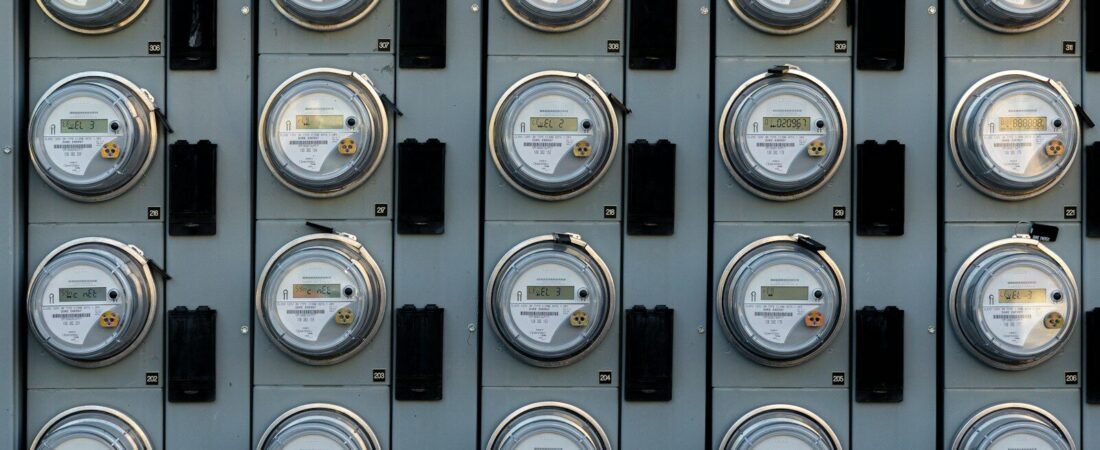
The largest single IoT opportunity Fibocom is chasing is India’s electricity smart-metering programme. Under the Revamped Distribution Sector Scheme (RDSS), the government has sanctioned 20.33 crore smart meters — about 19.79 crore consumer meters plus distribution-transformer and feeder meters — with an outlay of ₹3.03 lakh crore and a sunset date of 31 March 2028.
The programme is far from finished. As of 30 June 2026, about 5.73 crore meters had been installed under RDSS, and 7.24 crore across all schemes — roughly 28% of what was sanctioned, and up from 3.90 crore at the end of December 2025. The rollout has run behind schedule, and the deadline has already been extended. Hitting the 2028 target would require an installation pace in the lakhs per day, which independent analyses have called near-impossible to sustain.
Gap is the Opportunity
For module makers, that gap is the opportunity: every smart meter needs a communication module — GridCrest’s meters, for instance, use hot-swappable network interface cards supporting RF mesh, 4G, NB-IoT and dual-SIM — and hundreds of millions of meters still have to be built, deployed and maintained. Fibocom’s stated role is to supply the 4G connectivity inside GridCrest’s meter, positioning it in a market measured in crores of units.
It is worth understanding why metering is such a large prize for a module vendor. A smart meter is not a single device but the front end of an advanced metering infrastructure: the meter talks through a communication module — a hot-swappable network interface card in GridCrest’s design — over 4G, NB-IoT or an RF mesh, to a utility head-end platform that handles data collection, billing and analytics. Because the programme covers consumer, transformer and feeder meters, and because meters are deployed in crores, the module is a small component multiplied by a very large number. That is the arithmetic that draws suppliers like Fibocom to India.
The NavIC caveat
There is a complication the release does not mention. NavIC support is only as valuable as the constellation behind it, and independent reporting in March 2026 found NavIC operating below its minimum working threshold: roughly three usable satellites against the four needed for reliable positioning, following the failure of the NVS-02 replacement satellite to reach orbit and a run of rocket failures.
That is not a reason to dismiss NavIC support — the mandate for vehicle trackers remains, Indian Railways and coastal fisheries depend on the system, with plans for replacements — but it is a reason to treat the reliability of any NavIC-dependent product as an open question. It also could not be re-confirmed for October 2026: the constellation status may have improved, or worsened, since that reporting. A device maker specifying NavIC today is making a bet on India’s ability to restore the constellation on schedule.
The company behind the modules
Fibocom is a significant player. Founded in 1999, it describes itself as China’s first wireless communication module company listed on both the A-share and H-share markets, with more than 2,000 employees and business in over 100 countries. In the global cellular IoT module market, independent tracker IoT Analytics put it third, with roughly 8% of shipments, behind Quectel (about 40%) and China Mobile.
But the financials are under pressure. Fibocom’s H-share filing shows 2025 revenue of about RMB6.99 billion, down roughly 15% year on year, with profit down around 49%; its first-half 2026 profit fell more sharply again. That context matters: a vendor pushing into India’s IoT market is also a vendor looking for growth to offset a difficult home-market cycle.
The China-vendor question
Fibocom’s India expansion also lands in a sensitive spot. Chinese module vendors dominate the global market, but they face rising scrutiny: Quectel, the leader, has been on a US list of companies with alleged military ties, and Western device makers have begun evaluating alternative suppliers on security grounds. India, for its part, has tightened its posture on Chinese technology across telecom and electronics.
The release does not address this, and this article does not suggest any impropriety. But for Indian device makers and utilities weighing a module supplier — especially for critical infrastructure such as the electricity grid — the vendor’s origin and its exposure to shifting policy is a legitimate procurement consideration, sitting alongside price and performance. The market structure amplifies the issue. Cellular IoT modules are a concentrated business — the top five vendors account for roughly 73% of shipments, and most of them are Chinese — so device makers seeking to diversify away from Chinese suppliers have limited alternatives, and price remains the deciding factor for many. That is the bind India faces as it tries to localise a critical supply chain without simply swapping one dependency for another. It is the context in which Fibocom’s India push should read.
What to watch
For device makers, the milestones are whether Fibocom’s India-localised modules win volume programmes beyond named partners, and whether its NavIC variants ship in numbers. For utilities and metering service providers, the question is whether module supply keeps pace with the RDSS rollout as the 2028 deadline approaches. And, for policy watchers, watch whether India’s NavIC standards move from voluntary to mandatory, and how sourcing rules for critical-infrastructure components evolve. And for the module market, watch whether Fibocom’s localisation and partnerships translate into share against a dominant Quectel.

What the showcase does and does not establish
It establishes that Fibocom is courting India seriously, with local-band and NavIC support and partnerships with GridCrest and Grid-OS, aimed at real demand in metering and mobility. It does not establish a product launch, a committed order book, or independent proof of the products’ performance.
The showcase is a normal, low-cost way to signal presence in a market with a genuine, government-backed demand curve. The questions it raises — NavIC’s readiness, the metering programme’s pace, and the sourcing politics of Chinese modules in critical infrastructure — are the ones that will decide whether the presence becomes a business.
Editor’s Note: This article draws on the company’s announcement and publicly available documentation, plus government data, independent market research and reporting. Fibocom’s product and deployment claims have not been independently tested or verified. No interview or demonstration was conducted for this article. See the source list in the publication package.