
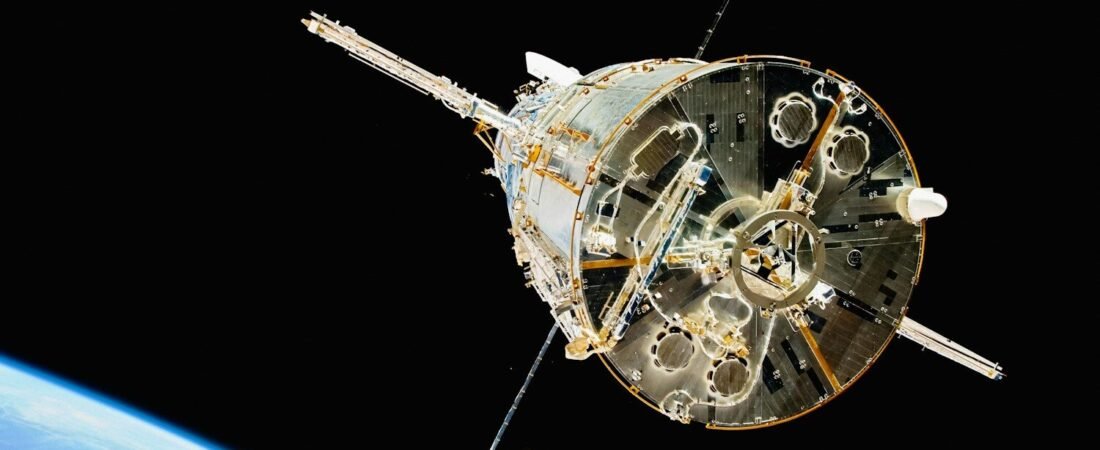
Cosmoserve Opens a Space Debris Removal Base, and a Cheaper Architecture
The facility is the announcement. The two-spacecraft model behind it makes a cost claim that would turn space debris removal from a government programme into a service.
Cosmoserve Space has opened Base 1 in Hyderabad, which it describes as India’s first private and the world’s sixth facility equipped with space vision effect and microgravity simulation, bringing satellite integration, robotic capture testing and mission control under one roof. The facility was inaugurated by Union Minister of State for Science and Technology Dr. Jitendra Singh and Telangana’s IT and Industries Minister D. Sridhar Babu. The company also closed a 6 million dollar seed round taking total funding past 9 million. The building matters less than the architecture it exists to test, and that architecture makes a specific cost claim the rest of the sector has not attempted.
What Base 1 actually contains
The facility houses four elements. An Orbital Rendezvous and Capture Lab simulates spacecraft capture operations. A Space Robotics Innovation Lab develops the robotic capture systems. An ISO Class 8 clean room handles satellite integration. And a Mission Simulation and Control Centre manages missions.
That combination is the point rather than an inventory. Testing a docking or capture mechanism normally requires a parabolic flight, a neutral buoyancy tank or an on-orbit demonstration, and each is expensive and infrequent. A ground facility simulating microgravity and space vision conditions lets a team iterate on capture hardware weekly instead of annually. Whether the simulation fidelity justifies the description is what a specialist would ask first and the release does not answer, but the intent is legible: move the iteration loop from orbit to the ground.
The architecture is the story
The technically interesting element is not the building. It is the Dual Spacecraft Architecture, described as a move away from the conventional one-to-one model in which a dedicated spacecraft services a single satellite.
Under the proposed model, a larger Orbital Service Station acts as an in-space logistics hub carrying fuel, equipment and spare parts, while a smaller Autonomous Service Vehicle travels to multiple satellites to capture, dock with, diagnose, repair or remove them. Two spacecraft, in principle, service many satellites.
The economic consequence is the claim worth examining. Cosmoserve says the architecture could bring servicing costs from around 10 million dollars per satellite to below 1 million. That order of magnitude separates a government-funded demonstration from a commercial service, and it follows from arithmetic rather than optimism: if the expensive asset is the station and it stays in orbit serving many targets, the marginal cost of each additional servicing call becomes the small vehicle’s fuel and time rather than another launch.
What the release does not supply is the basis for the figure. No mission cost model, no launch cost assumption, no number of satellites per station, and no indication of whether the sub-million figure includes the station’s own construction and launch. A cost claim of that size deserves a model, and the release offers only a target for the reader to take on trust.
The demand problem
The commercial puzzle in space debris removal is that the object needing removal usually has no owner willing to pay. A dead satellite generates no revenue, so its operator has no financial reason to fund a retrieval, and the benefit of removing it accrues to everyone else in the same orbital shell. That is a collective action problem, and it explains why every debris removal programme to date has drawn on government funding or guarantees. Cosmoserve’s architecture attacks the cost side of that problem and leaves the demand side untouched, which no architecture can fix. Whether space debris removal becomes a market depends on rules that assign liability or obligation, not on the price falling.
The honest failure
The most creditable sentence in the document concerns what went wrong. In July 2026 Cosmoserve flew its first payload, Mission Embrace, aboard Skyroot Aerospace’s Vikram-1, with flight hardware developed in under four months and six months ahead of schedule. The robotic capture petals did not deploy as planned.
Disclosing that is unusual and useful. A capture mechanism failing to deploy in flight is the most predictable failure mode for this class of hardware, and a company that says so in its own announcement is either confident about the diagnosis or serious about the engineering. The release says the mission provided valuable data for further development, which is the correct description of a partial failure and no more than that.
The Indian context
The Indian context explains the timing. The sector opened to private participation in 2020, the Indian National Space Promotion and Authorisation Centre now regulates it, and a wave of startups has emerged across launch, data and applications. Skyroot Aerospace, whose Vikram-1 carried the Mission Embrace payload, belongs to the same generation. What has been thinner is ground infrastructure for servicing and rendezvous work, which historically sat inside government laboratories. A private facility offering clean room integration, capture simulation and mission control together is the kind of capability that lets a startup iterate without competing for national test slots, and that is a structural change rather than one company’s milestone.
Hyderabad’s ecosystem claim is worth recording as the context for the facility’s location. Sridhar Babu says the state hosts more than 30 spacetech companies including India’s first spacetech unicorn, alongside 52 national labs, a talent pool of 1.5 million engineers and a local supply chain covering nearly 90 per cent of component needs, and that the government plans an exclusive Space City within the proposed Bharat Future City. That is a state government making a sector bet in public, and Base 1 is exactly the kind of facility such a bet requires to attract.
Local sourcing and the import question
Cosmoserve says it currently sources close to 60 per cent of mission components locally and intends to develop more critical technologies in-house through Base 1, specifically to reduce dependence on imported optics, avionics and space-grade electronics.
That is the part of the announcement with the widest relevance for Indian policy. Space-grade optics and avionics rank among the components most exposed to supply chain disruption and export control, and a debris removal mission needs them in quantity. A domestic facility pulling that content inward is doing something different from assembling imported subsystems, and the 60 per cent figure, while unexamined, is the number to track.
The market and the debris numbers
The case rests on figures the release supplies. Of roughly 28,000 satellites in orbit, nearly 10,000 are dead or non-operational, which is about 36 per cent. Beyond those, the release cites an estimated 68,000 debris objects smaller than 10 centimetres, 1.5 million fragments between 1 and 2 centimetres, and nearly 230 million pieces between 1 millimetre and 1 centimetre. Around 660 collisions and explosions have generated nearly 58,000 tracked fragments.
Those are the standard estimates used across the debris literature, and their import is that the tracked catalogue covers a small fraction of the objects capable of ending a mission. The release projects the global market for debris removal and servicing at 14.5 billion dollars by 2030, which is the figure that would need independent scrutiny before anyone plans around it.
Other approaches
Other active debris removal concepts in development have largely pursued single-target missions, often with a net, harpoon or robotic arm designed to capture one large object and deorbit it together with the chaser. Those missions are technically proven in principle and commercially difficult, because each costs a full launch for one removal. Cosmoserve’s two-vehicle model answers the same problem differently, and its advantage and its risk are the same property: the economics improve with volume, which means the architecture only pays off if the customer base arrives.
The funding
The funding is modest by space standards and proportionate to what is described. A 6 million dollar seed round taking total funding past 9 million supports a ground facility, technology demonstrations and two missions, which works only because those missions ride as payloads rather than dedicated launches. The investor mix deserves a note: Rebright Partners from Tokyo making its first Indian spacetech investment alongside three Indian funds, with AUM and Shakti both returning. That pattern, domestic capital following a Japanese lead, is becoming common in Indian deep tech and it signals a risk profile that has moved from unfundable to early-stage fundable.
What is missing
No capital cost appears for Base 1, no headcount, and no throughput figure, which matters because a facility only helps if it processes missions faster than launch cadence. The cost claim has no model behind it. The 60 per cent local sourcing figure carries no definition of what counts as a component. The two upcoming missions appear only as a number. And the full-scale debris capture demonstration scheduled for 2027 has no customer, no orbit and no target object named.
What to watch
Whether the microgravity flight tests of the capture system happen and what they show, since that is the hardware that failed on the first attempt. Whether Cosmoserve publishes the cost model behind the sub-million figure, because that is what would make the architecture a business rather than a concept. And, hether the 2027 demonstration names a target object and a paying customer, since active debris removal has no commercial market until somebody buys it. And whether the local sourcing share rises, which is the measure of whether Base 1 delivers the import substitution it was built to achieve.