
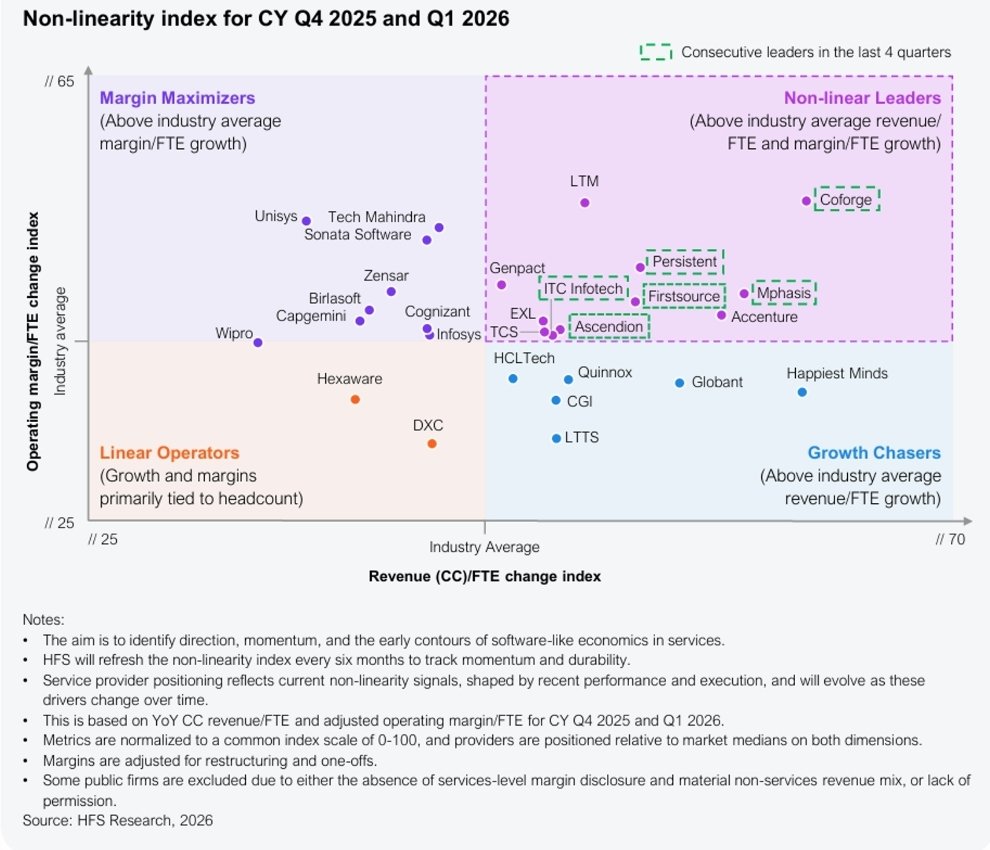
Coforge has emerged as a Non-Linear Leader in the latest HFS Non-Linearity Index. The recognition highlights the company’s ability to create greater business value without relying solely on workforce expansion.
Coforge Limited has been recognized by HFS Research as a Non-Linear Leader in its latest HFS Non-Linearity Index covering Q4 2025 and Q1 2026.
The assessment analyzed more than 25 major global services providers. Coforge was among only six providers identified as consistently demonstrating sustained non-linear growth over the past four quarters.
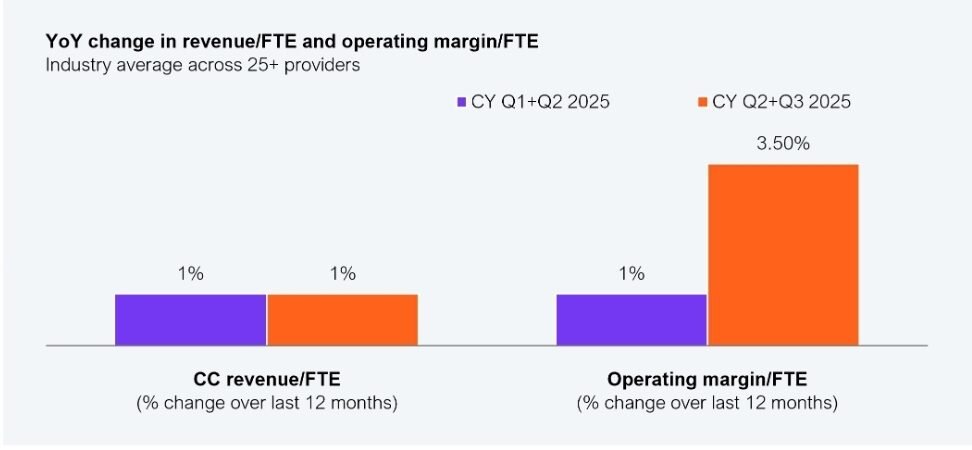
The recognition comes as the technology services industry moves beyond traditional headcount-led growth models. Service providers are increasingly using artificial intelligence, reusable technology assets, automation and outcome-based commercial models to improve productivity and operating leverage.
For Coforge, this transition has translated into performance above the industry average in revenue per full-time employee and operating margin per full-time employee.
Coforge non-linear growth reflects changing economics of IT services
HFS Research’s latest report, titled The Headcount Era Is Fading as the Pivot to Services-as-Software Continues, examines the changing economics of the technology services sector.
According to HFS, traditional linear growth has historically depended heavily on increasing workforce capacity. However, the growing adoption of AI and reusable technology platforms is enabling service providers to create additional value without proportional increases in headcount.
Coforge has been positioned twice in the Non-Linear Leaders quadrant during the last four quarters. Its performance reflects above-industry-average year-on-year constant-currency revenue per FTE and operating margin per FTE.
Saurabh Gupta, President at HFS Research, said Coforge’s move from Challenger to Leader demonstrates its ability to sustain non-linear growth while the services industry redefines how value is created.
He pointed to Coforge Nuuron and Momentuum blue as important elements of this transformation. He also highlighted the company’s increasing focus on outcome-based pricing.
The combination of AI, reusable platforms, specialized talent and disciplined execution is helping Coforge move toward a model where technology-led productivity becomes a stronger growth driver.
AI moves closer to the core of Coforge’s delivery model
Coforge’s AI strategy extends beyond experimentation and isolated generative AI use cases.
The company has more than 11,000 data and AI practitioners. Its AI ecosystem includes Coforge Nuuron, described by the company as its AI Operating System, along with eight AI platforms, 22 AI assets and nearly 130 reusable AI agents and accelerators.
These capabilities are designed to increase the use of AI and automation across technology delivery and operations.
The objective is to help enterprises modernize technology environments, improve operational performance and develop new business capabilities.
Coforge is also using its specialized FDE operating unit, Momentuum blue, to place engineers directly within client environments. This approach allows teams to build and deploy AI solutions closer to where business problems and operational requirements emerge.
The model represents a broader change in enterprise technology delivery. Instead of treating AI as an additional layer over existing services, providers are increasingly embedding AI into engineering, operations, delivery processes and workforce models.
Outcome-based delivery becomes a strategic differentiator
Another important component of Coforge’s strategy is its AI Mod Squads.
The company describes these as outcome-based delivery teams designed to apply AI to specific client requirements. Such models can potentially change how technology services are structured, measured and priced.
Rather than linking commercial growth primarily to the number of professionals deployed, outcome-oriented delivery focuses more directly on the business results generated.
This aligns with the wider Services-as-Software trend identified by HFS Research.
Coforge CEO and Executive Director Sudhir Singh said the company’s approach to non-linear growth is focused on creating greater value without depending solely on additional capacity.
He attributed the company’s sustained performance to embedding AI across delivery and operations, alongside outcome-based delivery through its AI Mod Squads.
The recognition therefore provides an external validation of Coforge’s efforts to build a more scalable operating model.
From workforce expansion to technology-led productivity
The significance of Coforge non-linear growth extends beyond the company itself.
For years, the technology services sector has largely operated on a model where revenue growth could be closely associated with workforce expansion. More employees meant greater delivery capacity and, consequently, greater potential revenue.
AI is challenging that relationship.
Reusable agents, automated workflows, specialized platforms and AI-assisted engineering can allow organizations to deliver more work with fewer incremental resources. At the same time, specialized human expertise remains critical for complex transformation programs and enterprise environments.
The emerging model is therefore not necessarily about replacing people. It is about increasing the amount of value each professional and technology asset can generate.
This is particularly relevant as enterprises seek measurable returns from their AI investments. Clients increasingly want faster delivery, lower operating costs, improved conversion and stronger margins rather than simply access to new technology.
Coforge’s strategy reflects this changing expectation.
Coforge positions AI as an enterprise growth engine
The company describes itself as an AI-native engineering services leader, with AI forming the foundation of how it designs, builds and delivers solutions.
Its approach combines AI agents with an AI-enabled workforce and specialized FDEs operating through hybrid, pod-based delivery units.
Coforge also emphasizes trusted AI, with a focus on secure, governed and enterprise-grade solutions.
The company’s stated objective is to move enterprises toward autonomous operations while delivering measurable business outcomes.
The HFS recognition suggests that this strategy is beginning to translate into improved operating economics.
For the wider IT services industry, Coforge non-linear growth offers another indication of how AI may reshape the relationship between workforce size, productivity and revenue.
As reusable intellectual property, AI agents and automation become increasingly embedded in enterprise delivery, the ability to scale value without proportionally scaling headcount could become an increasingly important competitive metric.
Coforge’s latest recognition places it among the service providers demonstrating this transition most visibly.
The company’s challenge now will be to sustain that productivity advantage while continuing to expand AI adoption, strengthen reusable technology assets and deliver measurable outcomes for enterprise customers.
If that balance is maintained, its non-linear operating model could become an important example of how the technology services industry evolves from people-intensive delivery toward AI-enabled, outcome-led growth.