BlueBinaries’ MicroNova Acquisition Targets the Testing Infrastructure Behind Software-Defined Vehicles
BlueBinaries is acquiring MicroNova’s automotive testing business as vehicle development moves toward a software-defined model in which testing must increasingly keep pace with software release cycles.
The Chennai-based engineering and technology company has signed an agreement to acquire the automotive testing business of Germany-based MicroNova AG. The carved-out operation will become NovaBinaries GmbH within the BlueBinaries Group.
The transaction brings together two different assets: BlueBinaries’ engineering and mobility delivery footprint, and MicroNova’s established technology for hardware-in-the-loop testing, test automation and virtualization.
MicroNova says the transaction includes its NovaCarts Hardware-in-the-Loop (HiL) product line, EXAM test automation platform, virtualization portfolio and associated test consulting services. Around 167 employees in Germany and the Czech Republic are associated with the business.
That makes the acquisition more significant than a conventional engineering-services expansion.
The technology sits inside a larger transition taking place across automotive development. As vehicles become increasingly software-defined, automakers need to test more software, more frequently and across more combinations of physical and virtual vehicle components.
The resulting challenge is not simply how to build another test bench.
It is how to create a validation environment that can operate continuously across the software development lifecycle.
Why Automotive Testing Is Becoming a Software Infrastructure Problem
Traditional vehicle development relied heavily on physical prototypes and progressively integrated hardware.
Software-defined vehicles change that equation.
A vehicle’s software stack can evolve independently of many physical components, while connected vehicles can receive software updates after deployment. That creates pressure to identify defects earlier, automate regression testing and move more validation into simulated environments.
Microsoft’s reference architecture for SDV development describes cloud-based virtual vehicle environments, Software-in-the-Loop (SiL), Hardware-in-the-Loop (HiL), CI/CD pipelines and automated test execution as components of an SDV toolchain.
Industry suppliers are pursuing similar architectures.
dSPACE has demonstrated CI/CT concepts integrating GitLab pipelines, SiL software and HiL platforms for continuous validation, alongside AI-supported approaches to software testing.
The direction is therefore broader than HiL alone.
The industry is moving toward a continuum in which software can be tested against simulated environments early, against increasingly realistic hardware later, and through automated pipelines throughout development.
That gives the BlueBinaries-MicroNova combination a more interesting technology context.
What BlueBinaries Is Actually Acquiring
MicroNova’s automotive portfolio is broader than a collection of physical HiL systems.
Its NovaCarts platform provides modular HiL simulators for testing electronic control units and vehicle electronics. The portfolio includes systems for areas such as engines, electric motors, batteries and broader vehicle system testing.
The technology can also connect physical and virtual environments.
MicroNova’s virtualization architecture allows real and simulated components to operate together. Its documentation describes environments ranging from fully virtual simulations to configurations combining physical control units with simulated vehicle components.
That is important because the long-term direction of automotive testing is unlikely to be “replace HiL with simulation.”
Instead, the architecture is becoming more heterogeneous.
Some components can be virtualized. Others still require physical hardware. A useful validation platform must allow engineers to move between those environments without rebuilding the entire testing stack.
MicroNova’s NovaCarts Virtual software illustrates that approach. The company says simulation models can run across HiL computers, local virtual machines and cloud configurations without requiring model redevelopment or recompilation.
The acquisition therefore gives BlueBinaries access to technology that already addresses the physical-to-virtual transition.
EXAM Adds a Different Kind of Asset
The second major component is EXAM, MicroNova’s test-automation platform.
EXAM allows test procedures to be graphically modeled and reused. MicroNova says it supports standardized testing processes and enables testing across departmental and organizational boundaries. Its core libraries are open source, while the overall tooling is offered under a freeware license.
More important from an acquisition perspective is its installed base.
MicroNova says EXAM has approximately 3,500 users, including more than 2,500 users within Volkswagen Group.
That does not automatically establish revenue, market share or competitive leadership.
It does, however, demonstrate that the technology has an established user ecosystem rather than being an acquisition of an unproven prototype.
That distinction matters when evaluating what BlueBinaries actually gains.
It is acquiring technology, engineering knowledge and an existing testing ecosystem at the same time.
From HiL to Continuous Validation
HiL remains important because virtual testing cannot reproduce every characteristic of physical hardware.
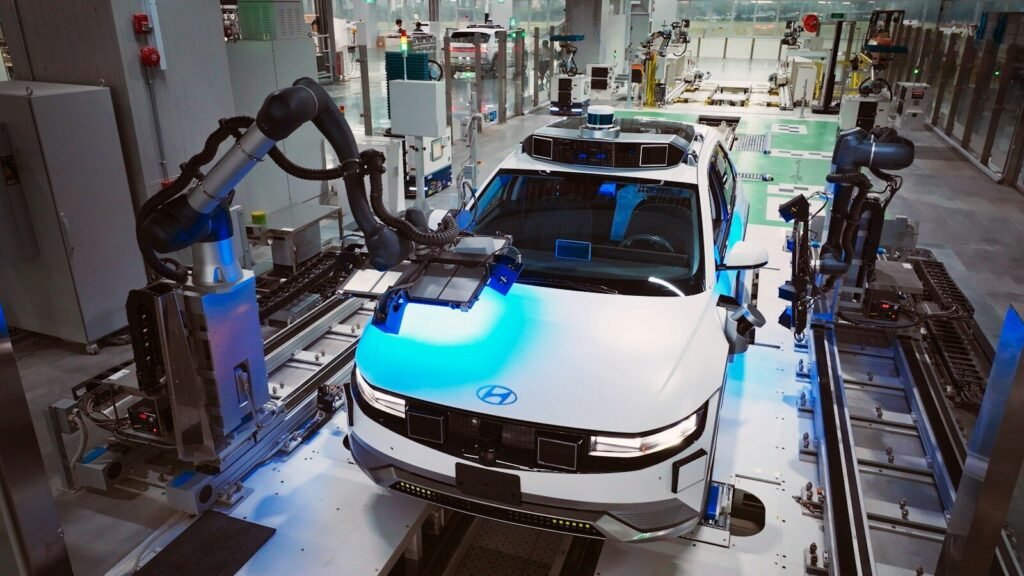
In a typical HiL environment, an actual ECU interacts with a real-time simulation of the system around it. Engineers can reproduce operating conditions, faults and other scenarios without placing the complete vehicle on a physical test track.
But HiL capacity can become a bottleneck when software development accelerates.
MicroNova has consequently developed virtualization and cloud-oriented approaches around its HiL portfolio. Its Connected Mixed Reality architecture can combine real, simulated and virtualized components, while its Test Cloud Controller can distribute EXAM test cases across execution instances.
This is where the concept of a Software Test Factory becomes relevant.
The idea is not simply to automate an individual test.
It is to create a repeatable infrastructure in which new software can automatically trigger appropriate test environments, execute large numbers of tests and return evidence to the development process.
That is increasingly compatible with CI/CD.
The acquisition gives BlueBinaries a technology portfolio that already contains several of those building blocks.
Where AI Fits — and Where It Does Not Yet
The companies position the acquisition within an automotive industry entering an SDV and AI era.
That claim needs careful interpretation.
The acquired products are fundamentally testing and validation technologies. The available evidence does not establish that NovaBinaries is acquiring a proprietary generative-AI testing platform or an autonomous AI validation system.
AI is becoming relevant to automotive testing, but it is a layer within a much larger architecture.
dSPACE, for example, has demonstrated AI-supported SiL and HiL approaches, including generative-AI-assisted creation of virtual ECUs for testing.
Potential AI applications include generating test cases, identifying anomalous results, analyzing failures, prioritizing regression tests and creating virtual scenarios.
But those capabilities still depend on reliable test infrastructure.
An AI system that generates thousands of test cases is of limited value if the organization cannot execute, reproduce and validate those tests at scale.
That makes the underlying test factory increasingly important.
What BlueBinaries Gains Beyond the Technology
BlueBinaries already operates in automotive engineering and testing.
The acquisition therefore appears designed to add productized technology and European engineering depth to capabilities the company already possesses.
MicroNova says Germany will become an important development hub for the expanded automotive business. The acquired team is also intended to preserve continuity for existing users of the HiL, EXAM and virtualization products.
This gives BlueBinaries several assets at once:
- established HiL technology
- test automation software
- virtualization capabilities
- automotive testing expertise
- an existing user base
- European engineering presence
- technology that can complement its existing testing services
That combination could help BlueBinaries pursue a broader role in SDV validation.
But the acquisition should not automatically be interpreted as proof that BlueBinaries has become a major global automotive testing-platform provider.
The company’s longer-term position will depend on how successfully it integrates the acquired products, retains customers and engineering talent, develops the technology and connects the portfolio to modern software-development workflows.
The Acquisition Also Reveals a Larger Industry Shift
The more interesting implication is not limited to BlueBinaries.
Automotive engineering suppliers increasingly need to connect several worlds that historically operated as separate domains:
software development, simulation, test automation, physical validation, cloud infrastructure and vehicle engineering.
That convergence is visible across the industry.
Synopsys, for example, describes automotive validation architectures spanning Model-in-the-Loop, SiL, Processor-in-the-Loop and HiL, together with continuous integration and digital-twin capabilities.
AVL similarly positions HiL, virtualization and continuous validation as parts of an integrated SDV testing environment.
BlueBinaries is therefore entering an established technology direction rather than creating the category.
Its differentiator will need to come from execution: how effectively it combines the acquired technology with its engineering capabilities, customer relationships and geographic reach.
What the Announcement Does Not Yet Answer
Several questions remain material for customers and technology buyers.
First, what changes for existing EXAM and NovaCarts users?
MicroNova says the transaction is structured to preserve continuity, but the longer-term product roadmap will matter more than the transition itself.
Second, how much of the combined proposition will be product-led?
BlueBinaries is traditionally positioned as an engineering and technology partner. The acquired portfolio gives it proprietary products and established technology, but the company has not publicly quantified how much of its future revenue will come from software, hardware, licensing and services.
Third, what exactly does the $50 million revenue figure represent?
BlueBinaries’ announcement describes approximately $50 million in projected annual revenue and a plan to reach $100 million in the coming years. Those figures should be treated as company projections rather than independently verified financial results.
Fourth, where will AI enter the product roadmap?
The companies refer to the SDV and AI era, but the publicly documented acquisition assets are primarily HiL, automation, virtualization and validation technologies.
That distinction matters.
AI can enhance a test factory. It does not eliminate the engineering infrastructure required to determine whether the test itself is valid.
What This Means for Software-Defined Vehicle Development
The BlueBinaries-MicroNova deal illustrates an important change in automotive technology.
Testing is moving from a downstream quality-control activity toward a continuous engineering capability.
As software becomes a larger part of vehicle functionality, validation must move closer to the development process itself. Simulation can move testing earlier. Virtualization can increase capacity. Automation can reduce manual execution. HiL can validate behavior against physical hardware. CI/CD can connect those activities to frequent software changes.
The resulting architecture looks less like a traditional test laboratory and more like a software infrastructure layer for the vehicle development lifecycle.
That is the opportunity BlueBinaries is acquiring.
Whether NovaBinaries can turn that collection of technologies into a coherent global platform remains to be demonstrated.
But the underlying direction is clear: the SDV race is also becoming a race to build better infrastructure for proving that automotive software works.
Editor’s Note
This article was independently researched using MicroNova’s product and transaction documentation, BlueBinaries’ announcement, Microsoft’s SDV reference architecture and public material from automotive testing technology providers.
MicroNova’s documentation establishes the acquired portfolio, including NovaCarts, EXAM, virtualization and associated services. Its documentation also reports approximately 3,500 EXAM users, including more than 2,500 within Volkswagen Group.
The $50 million projected revenue figure and $100 million growth target are treated as BlueBinaries’ stated projections, not independently verified financial results.
The article also distinguishes currently documented testing capabilities from future AI possibilities. It does not treat the acquisition as evidence that BlueBinaries has independently created a new automotive testing category.