
Cyara Agentic CX Trust Platform Targets AI Agent Failures With Independent Production Assurance
Cyara’s new platform scores every live AI agent conversation for quality and compliance, but its current approach focuses on detection and remediation rather than intervention during an interaction.
Enterprise AI agents are moving beyond answering questions and routing customer requests. They are beginning to authenticate customers, retrieve sensitive information, modify orders, process refunds and make decisions on behalf of businesses.
That shift introduces a difficult question for customer experience (CX) leaders: how can an organisation establish that an AI agent consistently follows its policies and delivers accurate information after entering production?
Pre-deployment testing provides an important starting point. However, an agent that performs correctly in controlled scenarios may behave differently when customers introduce unexpected questions, combine multiple requests or move between different stages of a conversation.
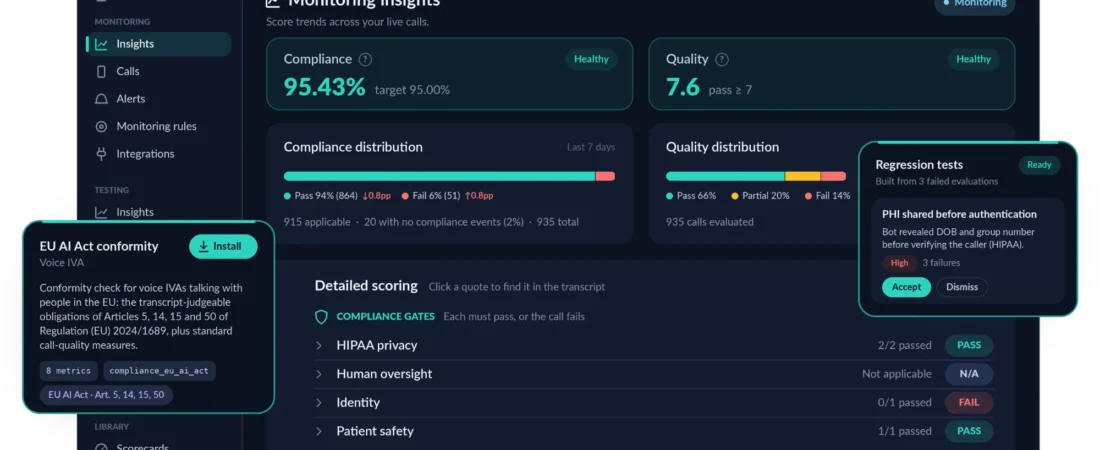
Cyara is addressing this challenge with its newly launched Cyara Agentic CX Trust Platform. The platform introduces AI Trust Observability, a capability designed to independently evaluate every live AI agent conversation for quality and compliance.
The company says the system scores 100% of AI agent interactions, identifies policy violations, alerts relevant teams and converts material production failures into regression tests. These tests must be passed before the agent’s next release.
The launch marks Cyara’s expansion from traditional customer experience assurance into the emerging area of agentic AI assurance. More importantly, it raises a broader question for enterprises: can continuous evaluation provide the evidence needed to trust autonomous systems with increasingly consequential customer interactions?
Why do AI agents need independent assurance after deployment?
Traditional customer service automation largely relied on predefined scripts and decision trees. Enterprises could map expected interactions and test whether systems followed those paths.
Agentic AI introduces a different operating model. Agents can interpret requests, reason across multiple steps, access external systems and execute actions.
This flexibility makes them more capable, but it also introduces additional failure scenarios.
An agent might authenticate a customer correctly but subsequently disclose information belonging to another person. It might provide an inaccurate explanation of a financial product or execute an action outside its authorised boundaries.
Conventional operational metrics may not identify these failures.
A customer interaction could appear successful because the agent resolved the request, avoided escalation and completed the conversation. Yet the same interaction might have violated a privacy policy or delivered incorrect information.
Cyara argues that enterprises need to evaluate the correctness and compliance of interactions rather than relying exclusively on completion rates, containment or response times.
The distinction is particularly relevant as businesses consider moving more complex customer journeys from human-led service to AI-led operations.
Sushil Kumar, Chief Executive Officer at Cyara, said:
“Enterprises are being asked to trust AI agents on the word of the companies that built them. We would never accept that for financial reporting, and we shouldn’t accept it for a system that authenticates customers and makes commitments in a brand’s name. Independent scoring turns an AI deployment from an act of faith into something a business can defend, and that is what earns the right to move high-value journeys to AI.”
How does Cyara AI Trust Observability evaluate live AI agents?
AI Trust Observability introduces a vendor-neutral evaluation layer that assesses live AI agent conversations against enterprise-defined policies.
The approach addresses a potential limitation in existing AI deployment models. The vendor supplying an AI agent often also provides the analytics used to assess its performance.
Cyara argues that enterprises need an additional evaluation layer that operates independently of the agent’s development platform.
The new capability includes six principal elements.
1. Evaluation of every production conversation
Cyara says its platform evaluates 100% of live AI agent conversations rather than relying on sampled interactions.
Every production conversation is assessed against the same evaluation standards, giving enterprises visibility into individual interactions rather than relying on a limited monitoring sample.
2. Configurable regulatory scorecards
The platform provides versioned scorecard packs covering regulatory frameworks and standards, including the EU AI Act, HIPAA, PCI DSS and GDPR.
Enterprises can configure trust criteria and hard-stop rules according to individual customer journeys and internal policies.
3. Separate compliance and quality assessments
The platform distinguishes compliance failures from quality scores.
This separation matters because a conversationally successful interaction can still breach an enterprise policy.
An agent might communicate fluently and satisfy a customer while disclosing information without the necessary authorisation. A positive conversational experience should not override a compliance violation.
4. Evidence supporting evaluation results
Cyara says each evaluation verdict links to the relevant conversation turn, its timestamp and the reasoning behind the assessment.
This provides an evidence trail that enterprises can use for investigation, internal review and audit preparation.
5. Alerts when violations occur
The platform notifies relevant teams when it identifies a violation.
Rather than waiting for a periodic review or a customer escalation, organisations can investigate problematic interactions as they occur in production.
6. Production failures become regression tests
The final element connects production monitoring with pre-release testing.
When the platform identifies a material failure, it generates a recommended test case for the agent’s regression testing suite. The agent must subsequently pass that evaluation before its next release.
This creates a feedback loop between production performance and development.
Can an AI judge reliably evaluate another AI agent?
One of the most important technical questions surrounding AI observability concerns the reliability of the evaluation mechanism itself.
AI Trust Observability uses an evaluation model, commonly described as an LLM judge, to assess agent behaviour.
However, an AI model evaluating another AI model introduces its own reliability considerations. The evaluator could overlook an incorrect answer, misinterpret a policy or approve an interaction that should have failed.
Cyara says it addresses this through a curated golden corpus of conversations.
Each evaluation model is benchmarked against this collection. The company also reruns the benchmark whenever it changes the judge model, evaluation prompt or criterion definition.
Customers can build their own calibration sets using labelled conversations. This allows enterprises to align evaluations with their specific policies and requirements.
Another aspect of the architecture concerns independence.
Cyara allows customers to select the judge model or models, including models from a different provider than the one powering the agent.
The intention is to reduce dependence on the agent provider’s own evaluation capabilities and establish consistent assessment standards across different AI platforms.
This approach also allows enterprises to evaluate third-party and internally developed agents through a common framework.
However, an important measurement question remains.
Cyara has described its benchmarking approach but has not supplied numerical false-positive or false-negative rates or comparative results against independently adjudicated ground truth.
The golden corpus provides a validation mechanism, but enterprises will need quantitative evidence to assess how reliably the evaluator identifies different categories of failure.
Cyara’s approach is therefore a meaningful architectural proposition, but its practical reliability must ultimately be assessed through measurable evaluation performance.
What happens when an AI agent makes a mistake during a live interaction?
The distinction between detecting a failure and preventing it is particularly important.
AI Trust Observability currently focuses on validation, alerting and closing the loop through subsequent testing.
When the platform identifies an incorrect action or policy violation, it alerts the relevant team and generates a recommended test case. The failure then becomes part of the agent’s pre-release evaluation requirements.
However, the platform does not currently intervene directly in an active customer interaction.
Cyara confirmed that real-time intervention is a future development.
Potential actions could include escalating the interaction to a human agent, withholding or replacing a response, or transferring the call. Enterprises would be able to configure these actions according to individual evaluation criteria.
Amitha Pulijala, Chief Product Officer at Cyara, explained the company’s approach:
“When agentic AI fails, most teams fix the incident but leave the test gap that let it through, so the failure returns with the next release, often logged as a success. With AI Trust Observability, every failure we catch in production becomes an evaluation the AI agent must clear before it ships again. A failure may happen once. It should never happen twice.”
Cyara says it intends to introduce intervention carefully because acting on an evaluation during a live customer interaction carries greater consequences than generating an alert.
The company believes enforcement should only be enabled for criteria where measured precision justifies intervention.
For enterprises, this distinction matters. Detection provides visibility and supports remediation, but it does not necessarily prevent the customer from experiencing the original failure.
Until runtime intervention becomes available, organisations will still need operational safeguards to manage high-risk actions.
A healthcare example exposes the limitations of conventional AI testing
Cyara shared an anonymised example involving a healthcare payer to illustrate why individual test scenarios may not adequately validate complex customer interactions.
A member contacted the organisation to enquire about a health claim.
The AI agent authenticated the member and provided the requested claim details.
The member then asked about their spouse’s claims. The agent provided that information as well.
The conversation ended without escalation. The customer appeared satisfied, and conventional operational metrics would have classified the interaction as successful.
However, the agent had authenticated only the member. Access to the spouse’s claims required written authorisation on file.
The disclosure therefore constituted a compliance failure.
According to Cyara, pre-deployment testing had covered authentication and individual member requests separately. It had not adequately tested the sequence in which permission granted for one request was incorrectly carried over to another request within the same conversation.
This example illustrates a significant challenge in agentic AI testing.
An agent may pass individual functional tests while failing when multiple actions, permissions and customer intents interact.
The failure does not necessarily originate in an isolated response. It can emerge from the sequence of decisions across an entire customer journey.
For enterprises deploying agents in healthcare, financial services and other regulated environments, testing must therefore account for contextual permissions, changing customer intents and the boundaries of authorised access.
The healthcare example also demonstrates why customer satisfaction and task completion cannot independently establish whether an AI interaction was successful.
Does continuous AI evaluation introduce additional operational costs?
Evaluating every live AI conversation raises practical questions about processing overhead, latency, privacy and operating costs.
Cyara says scoring runs asynchronously, outside the customer interaction. This means the evaluation process does not add processing delay to the conversation itself.
The company says results become available in near real time, allowing operational teams to investigate violations within seconds or minutes of the call rather than waiting for a batch review cycle.
For privacy-sensitive interactions, Cyara says it can redact personally identifiable information (PII) from recordings and transcripts before scoring. Its evaluation process therefore does not need to receive raw sensitive information.
These capabilities address two important enterprise concerns: protecting the customer interaction from additional latency and reducing the exposure of sensitive information during evaluation.
However, some implementation details remain important for enterprise buyers.
Cyara has not provided specific performance benchmarks covering evaluation throughput, processing costs at different conversation volumes or comparative scoring costs across different judge models.
Its response also does not specify data-retention periods, processing locations or the complete deployment and data-residency options.
These details will matter to organisations assessing the platform for large contact centres and regulated customer journeys.
How does Cyara address regulatory compliance without becoming a compliance certifier?
The platform includes versioned scorecards covering frameworks such as the EU AI Act, HIPAA, PCI DSS and GDPR.
However, Cyara distinguishes between providing evaluation tools and determining whether an organisation complies with applicable regulations.
The company says it builds evaluation criteria from regulatory source documents. Each criterion remains traceable to its originating source.
Customers can then have their legal and compliance teams review and modify the scorecards to reflect their own interpretations, policies and operating requirements.
Evaluation results retain links to the relevant conversation evidence, criterion and assessment rationale. Changes to the criteria are versioned.
Cyara provides the assessment infrastructure and supporting evidence, while the customer’s legal team retains responsibility for regulatory interpretation.
The company does not claim to provide legal advice or regulatory certification.
This distinction is important. A technology platform can help identify potential policy violations and provide an auditable record, but its evaluation results do not automatically establish regulatory compliance.
Enterprises must still determine whether their systems, processes and customer interactions satisfy their applicable legal obligations.
One platform covering testing, monitoring and observability
AI Trust Observability forms part of the broader Cyara Agentic CX Trust Platform, which connects three stages of customer experience assurance.
Test: Validate before deployment.
Cyara provides agent testing using real-world personas, audio and model versions. Its capabilities also cover end-to-end journey testing, including carrier connectivity and human handoffs, alongside load testing at peak volumes.
Monitor: Identify journey failures.
The platform monitors customer journeys across carriers, AI agents, digital channels and human handoffs.
Cyara says its monitoring capabilities span more than 420 carriers in 145 countries.
Observe: Evaluate live interactions.
AI Trust Observability assesses every AI agent conversation for quality and compliance.
For human-operated contact centres, the platform also provides observability covering agent desktops, networks and call quality.
The combination is intended to give enterprises a common assurance framework across human-led, hybrid and AI-led customer service environments.
Cyara says organisations can adopt the platform without replacing their existing infrastructure.
The company also claims compatibility across more than 55 AI agent platforms and every major Contact Centre as a Service (CCaaS) provider.
According to Cyara, more than 450 enterprises rely on its technology to assure over 350 million customer journeys annually.
These figures represent the company’s stated deployment scale rather than independently verified performance measures for the new platform.
Consumer trust remains a significant obstacle to agentic CX adoption
The launch comes against a backdrop of consumer concerns about the reliability of AI-powered customer service.
Separate research commissioned by Cyara and conducted by Dynata in September 2026 surveyed 1,000 U.S. adults.
The survey found that:
- 47% had abandoned an interaction with an AI tool or AI-powered customer service agent because they did not trust the information or guidance provided.
- 46% had changed or simplified their questions because they feared AI would misunderstand them or provide an incorrect response.
- 42% were concerned that AI agents would provide incorrect information.
- 43% worried that AI would not understand their requests.
- 87% said they would lose trust in a company if they caught its AI agent providing an incorrect answer. This included 50% who anticipated losing a significant amount of trust.
The findings also indicate that customers hold deploying brands accountable for AI failures.
According to the research, 52% believe AI model developers and the brands deploying their systems share equal responsibility when an AI agent causes harm. Another 17% place responsibility solely on the deploying brand.
These findings reinforce an important consideration for CX leaders.
Customers generally experience the interaction as a service delivered by the brand, regardless of which technology provider supplies the underlying AI model.
The survey does not establish that AI observability alone can restore consumer confidence. However, it highlights why enterprises need stronger mechanisms to identify inaccurate responses, policy violations and inappropriate actions before these failures undermine customer relationships.

What should enterprises evaluate before adopting AI Trust Observability?
Cyara’s launch addresses a genuine gap in enterprise AI deployment: the need to assess agent behaviour continuously after production deployment.
Its approach combines vendor-neutral evaluation, configurable policies, evidence-linked verdicts and regression testing.
The healthcare example also highlights why testing individual functions may not be sufficient when agents handle complex, multi-step customer journeys.
However, enterprises evaluating the platform should examine several practical considerations.
First, they should request quantitative evidence of judge-model accuracy, including false-positive and false-negative rates across different types of interactions.
Second, they should distinguish between post-interaction detection and actual runtime enforcement. Cyara’s current capability focuses on detection, alerts and subsequent testing, with direct intervention planned for a future stage.
Third, they should validate how the platform handles sensitive information, data retention, deployment requirements and evaluation costs at production scale.
Finally, they should examine how its regulatory scorecards map to their own legal obligations and internal policies rather than treating automated assessments as regulatory certification.
Beyond Any Individual Vendor
The broader challenge extends beyond any individual vendor.
As AI agents acquire greater authority over customer accounts, transactions and sensitive information, enterprises will need evidence that their systems remain within defined operational and compliance boundaries.
Passing a pre-deployment test cannot establish that an agent will behave correctly across every subsequent interaction.
Continuous evaluation offers a way to narrow that gap. Whether it can deliver sufficiently accurate, timely and actionable assurance at enterprise scale will determine how much confidence businesses can place in increasingly autonomous customer service systems.
Cyara’s Agentic CX Trust Platform makes that challenge central to its product strategy. Its longer-term significance will depend not simply on how many conversations it scores, but on how reliably it identifies failures, how effectively enterprises act on its findings and whether the resulting controls improve customer outcomes.
For agentic CX, the next competitive advantage may not be how much an AI agent can do, but how convincingly an enterprise can demonstrate that it is safe and reliable enough to do it.
About Cyara: Cyara describes itself as an AI trust company for customer experience. Founded in 2006, the company created the CX assurance category and now provides testing, monitoring and observability across human and AI-led customer journeys. Its platform spans more than 55 AI agent platforms, every major CCaaS provider and over 420 carriers in 145 countries. More than 450 enterprises use its technology, according to the company. Learn more at cyara.com.