
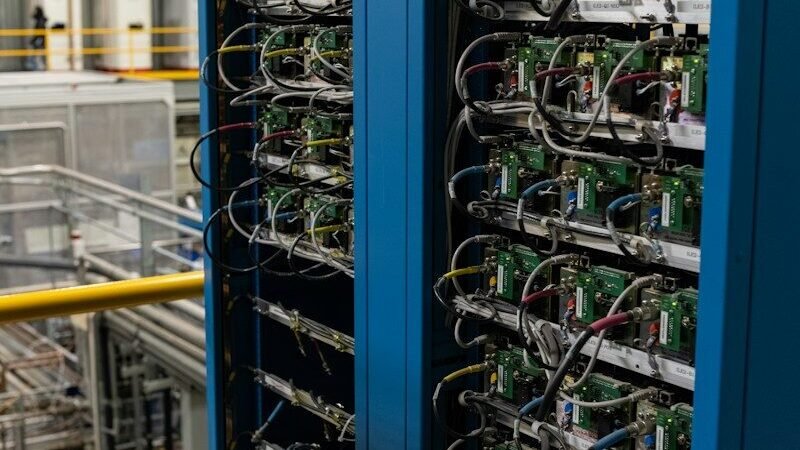
Data centre power: CHINT’s prefab Power Pod pitch
CHINT, a power and energy equipment maker, used Data Centre World Asia 2026 in Singapore to showcase a factory-built “Power Pod” — a containerized electrical system it says can cut on-site installation time by up to 60% compared with field-built systems, with deployment possible in as little as a week once the unit arrives. The company also previewed a solid-state transformer aimed at future data centre power architectures.
The pitch rests on a claim that is easy to test against public evidence: “Power is now the hardest part of building AI infrastructure,” said Paul Lee, CHINT’s APAC strategic segment director. He argues operators “don’t need another pile of components to integrate, wire, and commission on site — they need a single, factory-validated power block they can install and switch on.” The context is a build-out that has outrun the electrical supply chain. Data centre operators are no longer waiting only on chips and servers; they are waiting on transformers, switchgear and grid connections.
Prefabrication is one response, and CHINT is not alone in pursuing it — but the company is framing it as a product rather than a project, which is the more interesting claim. In this telling, data centre power becomes something you order from a catalogue rather than assemble on a site.
That framing is well supported. The International Energy Agency estimates data centre electricity consumption at around 415 TWh in 2024 — about 1.5% of global electricity — growing at 12% a year, and projects it to roughly double to about 945 TWh by 2030. It found data centre demand surged 17% in 2025. But the harder constraint is not generation; it is the equipment and connections that deliver power to the rack.
Why power is the bottleneck
The IEA’s own framing is that the technology sector can stand up a data centre in two to three years, while the energy system needs longer lead times for planning, construction and investment. Its analysis of the energy system’s response is blunt. Building new transmission lines can take four to eight years in advanced economies, and wait times for critical grid components such as transformers and cables have doubled in the past three years. The IEA has warned that around 20% of planned data centre projects could face delays unless grid risks are addressed.
Transformer lead times have become a specific pinch point: industry estimates put low-frequency transformer lead times approaching five years, up from 18 to 24 months only recently. The consequence is that a data centre project’s critical path increasingly runs through electrical equipment rather than construction. A hyperscaler can procure GPUs, build a shell and install cooling on predictable schedules; the transformer and the grid connection are the items most likely to slip. Prefabrication attacks only part of that problem — it speeds the on-site assembly of gear that has already been delivered — but it addresses the part operators control most directly.
That is the gap a prefabricated power pod aims to narrow. If the electrical gear arrives pre-assembled and factory-tested, the site work compresses from a build project into an installation. The claim is not that the pod makes power cheaper; it is that it makes power arrive sooner, which matters because a data hall that has no power cannot earn.
The pod’s pitch and its claims
The Power Pod is a fully enclosed, containerized system engineered for outdoor installation. It integrates switchgear, transformer and circuit protection alongside supporting systems — cooling, fire protection, lighting and security — all pre-assembled and factory-tested before shipping. CHINT says it manufactures and tests most of the core equipment in-house at its own facility, giving a single point of accountability from build through validation.
The savings figures deserve the usual care. The 60% installation-time reduction and the one-week deployment are CHINT’s own claims, not independently measured outcomes, and they compare against a hypothetical field-built baseline. The capacity range is also worth pinning down: the release says configurations run “from 500kW to 4,000kW,” while CHINT’s own Power Pod product sheet lists 1,600–3,000 kVA for the configuration it documents — different units and a different range, which suggests the figures cover different product variants rather than a single specification. CHINT also says the pods are container-grade shippable and modular, allowing phased capacity expansion rather than an oversized upfront build — a real consideration when a facility’s eventual load is uncertain.
Prefabricated Power Category
None of that undermines the concept. Prefabricated power is a real and growing category, and the “product you order, not a project you build” framing captures a genuine shift in how operators procure data centre electrical infrastructure. The open question is whether the pods are shipping into named projects, which the release does not say. There is also the question of what the pod does not include. A containerized unit integrating switchgear, transformer and protection still needs a grid connection, and the grid connection is often the longest lead item of all. The pod compresses the work behind the meter, not the queue in front of it. In other words, data centre power deployment runs on two clocks, and the pod controls only one of them. That distinction matters when the IEA’s warning about project delays is driven substantially by connection queues and component shortages rather than by site labour.
The solid-state transformer and the 800 VDC shift
The more consequential part of the showcase is the solid-state transformer, or SST. CHINT describes it as a building block for future HVDC data centre architectures, cutting the number of conversion stages — and the losses — between the grid and the IT rack. Its own literature specifies a 1.75 MW unit, about 98.5% efficient, stepping 10 kV AC down to 800 V DC using silicon-carbide devices and high-frequency magnetics in place of an oil-filled, line-frequency transformer.
That aligns with a broader industry move. NVIDIA is driving a transition to 800 VDC power distribution to support 1 MW racks from 2027, converting 13.8 kV AC directly to 800 VDC at the data centre perimeter and eliminating intermediate conversion steps. NVIDIA cites gains including up to 5% end-to-end power efficiency and up to 30% lower total cost of ownership. Solid-state transformers are central to the facility-level version of that shift: analysts describe them as collapsing the medium-voltage transformer and rectifier into a single power-electronic stage, with vendors targeting meaningful efficiency gains.
This is where CHINT’s technology roadmap meets the direction of the largest buyer of AI infrastructure. The engineering logic is straightforward. Higher voltage means lower current for the same power, which means less copper, smaller conductors and fewer losses — a meaningful consideration when a single rack can draw a megawatt. Analysts tracking the transition describe a staged adoption, starting with rack-level retrofits and moving to facility-level DC distribution as solid-state transformers mature. CHINT’s entry is a bet that this shift arrives on schedule, and that a prefabricated power block and a solid-state transformer belong in the same portfolio.
What to watch
For CHINT, the test is whether the Power Pod and SST move from showcases into named deployments, and whether the installation-time claims hold in practice. For operators, the question is whether prefabricated power genuinely shortens the path from delivery to an energised hall, and at what cost relative to a conventional build. And, for the wider market, there is a strategic wrinkle: the IEA notes that some critical data centre power technologies depend on inputs from a small number of producers, notably China. As the world’s data centres concentrate their power supply chains, the same concentration that makes prefab supply efficient also makes it a point of geopolitical exposure.
There is a second strategic question. If prefabricated power becomes the norm, the market consolidates around a handful of equipment makers who can manufacture and test at scale — and CHINT is positioning itself as one of them. For operators, that promises faster deployment; it also deepens dependence on a small supplier base. In short, data centre power is becoming a strategic input, and strategic inputs invite scrutiny.

What the announcement does and doesn’t establish
It establishes that CHINT has a containerized power product and an SST, that both address real bottlenecks, and that the company is marketing them into Asia Pacific’s data centre build-out. It does not establish a customer, an order, a price, or any independently measured saving. The capacity figures in the release and the product sheet do not match.
What the release does show, indirectly, is how the industry’s centre of gravity has moved. A power-equipment company now markets directly to the AI data centre market, at a data centre event, in the language of deployment speed and rack density. For buyers, data centre power has become a product category in its own right, not a background utility. The honest summary is that CHINT is selling a sensible answer to a documented problem. Power infrastructure is the constraint the IEA, NVIDIA and the transformer market all point to, and compressing on-site electrical work is a rational response. But this was a trade-show showcase: the engineering story is credible, the savings claims are the company’s own, and CHINT has yet to demonstrate a deployment record.
Editor’s Note: This article draws on the CHINT release, CHINT’s Data Center Power Pod and Solid-State Transformer product literature, the IEA’s Energy and AI analyses and Electricity 2026, and NVIDIA’s 800 VDC architecture documentation. The installation-time, deployment and capacity figures are as stated by CHINT; the release named no customers, orders or pricing. No interview was conducted.