
Volvo Autonomous trucking Solutions and Waabi have begun moving freight for a paying customer in Texas. It is the first such operation in their partnership. The milestone comes with a caveat the companies state plainly: in autonomous trucking’s latest step, a human observer is still in the driver’s seat.
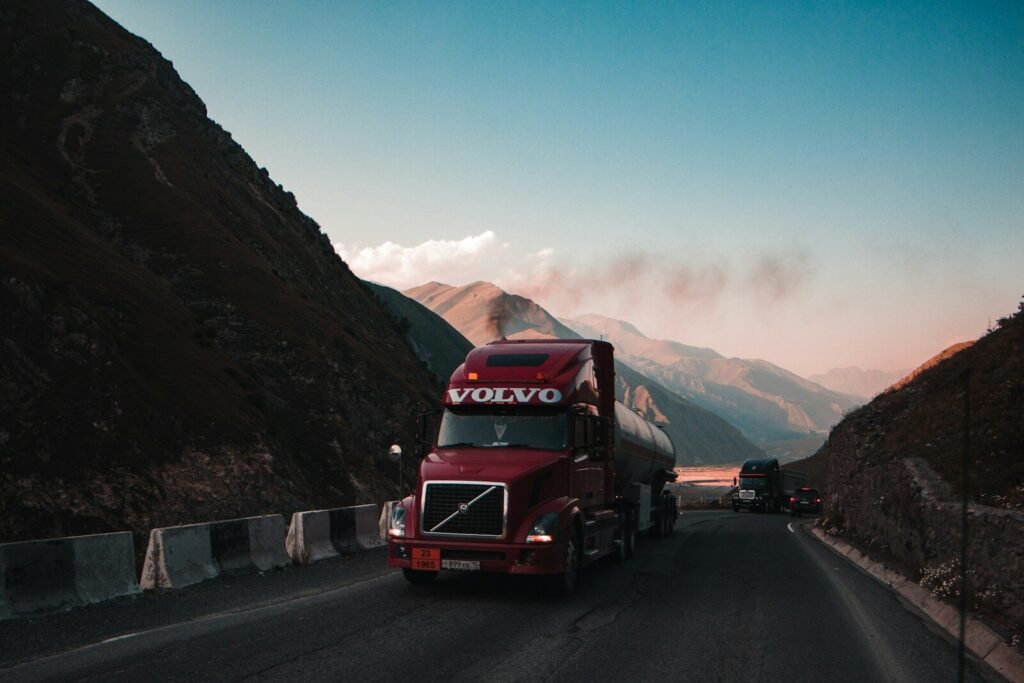
The two companies announced on 5 October that the Volvo VNL Autonomous, running Waabi’s self-driving software, is hauling goods along the Dallas-Houston corridor for Warp, a freight network serving customers including Walmart, DoorDash and Gopuff. It delivers directly to third-party facilities.
What started
The operation is the first customer deployment in the Volvo-Waabi partnership, announced in February 2025 and integrated later that year. It brings together Volvo’s autonomous truck platform, Waabi’s driving system, and Volvo’s Autona freight ecosystem for fleet management, terminals and support.
The Volvo VNL Autonomous is built for autonomy, with redundant systems for six safety-critical functions. Waabi says its driver transferred to the truck with no retraining — a “zero-shot” move the company frames as central to scaling.
The catch: an observer is still in the seat
For all the milestone language, these are not driverless hauls. Volvo and Waabi say an observer rides in the cab on every run. That places them a step behind rivals that have already removed the person.
Aurora launched the first driverless commercial trucking service on US public roads in Texas in May 2025. It has since logged more than 500,000 driverless miles across ten routes. Kodiak AI runs 35 driverless trucks commercially in the Permian Basin and is preparing to launch driverless long-haul on the same Dallas-Houston lane by the end of 2026, with IKEA as its launch shipper.
Volvo says it will go fully driverless on US highways from the first quarter of 2027, with more than 300 autonomous trucks targeted by the end of next year. Waabi’s chief operating officer has said the system is ready, pending Volvo’s final validation.
Where autonomous trucking sits in the driverless race
Waabi’s argument is that its system generalises, which is what makes scale cheap. In June, the company said its driver moved onto the Volvo truck — a different shape, sensor layout and control system — from the first mile, with no new real-world data, simulation or fine-tuning. In September, it said the same driver ran a new Dallas-San Antonio lane zero-shot.
The commercial numbers support the case. Waabi says load volumes on the Dallas-Houston corridor grew more than 80% in 2026. It also says it completed nearly 200 trips for a Fortune 50 retailer with zero safety incidents and 100% on-time pickup and delivery.
The corridor itself explains the interest. Interstate 45 connects two of America’s largest logistics hubs across roughly 240 miles, and carries more than 9,000 freight trucks a day. It also carries some of the country’s worst truck bottlenecks.
The freight that matters
Warp brings the less-than-truckload dimension. LTL freight consolidates goods from many customers on tight schedules — a harder coordination problem than point-to-point hauling. Warp’s pitch is that autonomy becomes more valuable when the network around it is orchestrated.
Waabi is also expanding into robotaxis, with a deal to put at least 25,000 driverless vehicles on Uber’s platform. Its driver is meant to be a shared “brain” across trucks and cars.
What to watch
Whether the observer comes out. Volvo’s Q1 2027 driverless target and Kodiak’s end-2026 launch will set the benchmark. Whether the single Texas lane expands into a network, as both companies promise. And whether autonomous capacity changes freight economics enough for shippers to commit at scale.
Autonomous trucking has proved it can drive. The open question is when it can drive alone.
Editor’s Note
Sources: Volvo Autonomous Solutions and Waabi’s release of 5 October 2026; Volvo’s and Waabi’s own technical disclosures; and reporting on Aurora, Kodiak AI and the wider autonomous trucking market. The “first customer operation” claim is the companies’ own and is specific to the Volvo-Waabi partnership. The observer-in-cab detail is from the release. TechRecast has not independently verified performance figures. This article is not investment advice.