
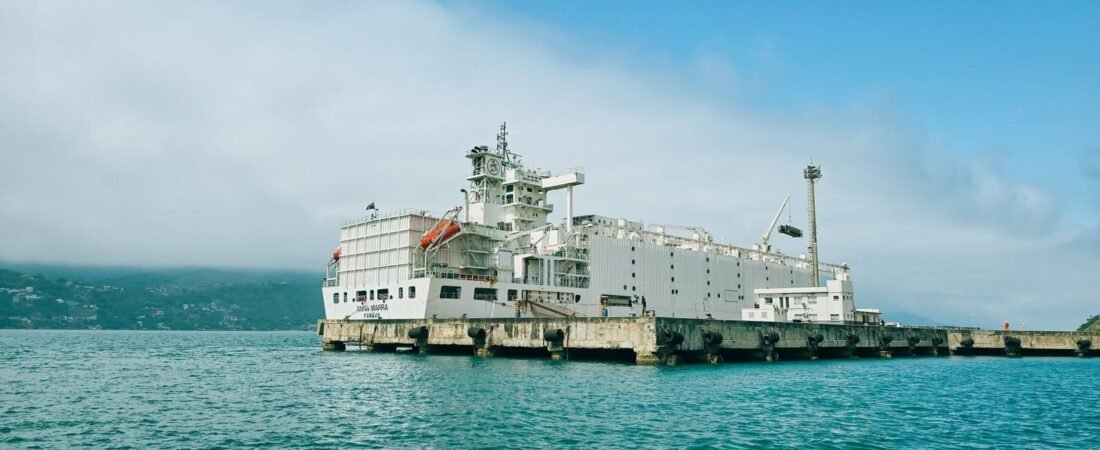
Floating data centers moved from concept to contract in 2026. In a single year, Japanese shipping giant MOL signed up Hitachi to convert a second-hand vessel into one. Samsung Heavy Industries began engineering 50 MW units for Texas. Karpowership’s Kinetics arm pushed a design that pairs a floating power plant with servers on board.
The pitch is the same in each case. Put AI compute on the water, cool it with seawater, and skip the queue for a grid connection.
Why the grid is the bottleneck
The constraint on AI build-out is no longer the chip. It is the power. At the end of 2024, the US interconnection queue held about 2,060 gigawatts of generation and storage. That is roughly double the country’s entire installed capacity, according to Lawrence Berkeley National Laboratory.
The waits are long and getting longer. The median time from an interconnection request to commercial operation has passed four years. For projects built in the early 2000s, it was under two. In the PJM zones serving the largest AI campuses, it approaches seven years.
JLL’s 2026 outlook puts the US average at about four years. A 100 MW connection in Northern Virginia is put at roughly seven.
Equipment compounds the problem. Transformer lead times rose from about 50 weeks in 2021 to roughly 120 by 2024. Some large units are now reporting above 160 weeks.
In June 2026, FERC ordered all six regional grid operators to justify or reform their rules for connecting large loads. The World Economic Forum captures the mismatch neatly. A facility can take four to ten years to connect. An AI data center is built in two to three.
What floating data centers actually are
A floating data center is a data hall built onto a barge or a converted ship. It is moored near shore, cooled by seawater, and often powered by an adjacent floating power plant. The concept trades land and grid access for the sea.
The 2026 pipeline is broad. MOL and Kinetics are targeting a 20–73 MW vessel by 2027, using seawater or river water for cooling. Samsung Heavy Industries and Mousterian signed an engineering contract in August. It covers 50 MW moored units bound for Texas, with a concept extended to 200 MW. Seatrium has a 30 MW pilot built from six modular 5 MW units.
Hanwha Ocean’s 60 MW design won approval-in-principle from the classification society ABS. So did HD Korea Shipbuilding’s 100 MW barge-mounted plant.
Around the edges sit more radical bets. Atomarine, a Y Combinator startup, wants nuclear-powered barges and is targeting 2028. Panthalassa raised US$140 million for autonomous, wave-powered platforms. China already runs a wind-powered underwater data center in Shanghai, which reached full commercial operation in May 2026. Singapore’s Keppel is building a four-storey floating facility for 2028.
The Karpowership route
Kinetics, Karpowership’s energy arm, markets the most self-contained version. Its “Intelliship” vessels combine power generation and compute on one hull. They run on gas blended with hydrogen and ammonia, capture carbon into depleted gas wells, and never touch the grid.
The company is putting money behind it. Karpower Valley, its US subsidiary, bought the former Seatrium AmFELS shipyard at the Port of Brownsville, Texas, in January 2026. The price was about US$50.6 million. It plans to invest roughly US$3 billion and build a 2 GW power plant alongside.
Then came the detail that undercuts the green framing. In July 2026, Texas regulators approved an air permit for Karpower Valley’s “Brownsville Power Ship.” It covers 12 gas-fired engines generating up to 248 MW. The plant could emit more than a million tons of greenhouse gases a year, and nearly 754 tons of criteria pollutants. A floating data center may dodge the grid, but it does not dodge the fuel.
The problems the ocean doesn’t solve
Four issues sit outside the seawater-cooling story.
First, scale. Hyperscalers are building multi-gigawatt campuses. Floating units range from 20 to 200 MW. Shipyards may deliver speed, but not the economies of scale that make land-based mega-campuses cheap.
Second, serviceability. Submerged designs cool best but cannot be upgraded, and AI chips turn over every two to three years. That is why most commercial interest has shifted to floating, serviceable platforms. It is also why Microsoft shut its underwater Project Natick, despite strong reliability results.
Third, latency. Platforms that rely on satellite links suit batch workloads like training runs, not interactive inference. Consumers expect instant answers; the open ocean is not built for that.
Fourth, environment and governance. Warm-water discharge can affect oxygen levels, pH and marine life. UNESCO estimates about 60% of marine ecosystems are already degraded. Legal scholars note that international law does not clearly define an underwater data center. It does not say who is liable when one fails, or what standards it must meet.
What to watch
Three signals will show whether this becomes an industry or a curiosity. Whether the 2027 pilot units actually begin operating. Whether floating compute proves cheaper than land once cooling, mooring, cables, maintenance and fuel are all counted. And whether regulators define the category before the projects scale.
For now, the honest reading is simple. The ocean solves the two easiest problems — cooling and grid access — and leaves the hard ones untouched. Floating data centers look like a niche answer for land-constrained, grid-blocked sites, not the future of AI compute.
Editor’s Note
Sources: the Karpowership–Seatrium release of 5 October 2026; company announcements and MoUs from MOL, Hitachi, Samsung Heavy Industries, Mousterian, Seatrium, Hanwha Ocean, HD Korea Shipbuilding, Kinetics, Atomarine, Panthalassa and Optimal Transit; classification-society approvals from ABS and Bureau Veritas; grid data from Lawrence Berkeley National Laboratory, JLL, the World Economic Forum, FERC and the IEA; and the Texas Commission on Environmental Quality air permit. Reporting and analysis came from Bloomberg, Data Center Dynamics, Data Center Frontier, New Scientist, The Register, The Conversation, CleanTechnica and arXiv. Project capacities, timelines and investment figures are as stated by the companies involved; most projects remain at engineering or approval stage. TechRecast has not independently verified them. This article is not investment advice.