

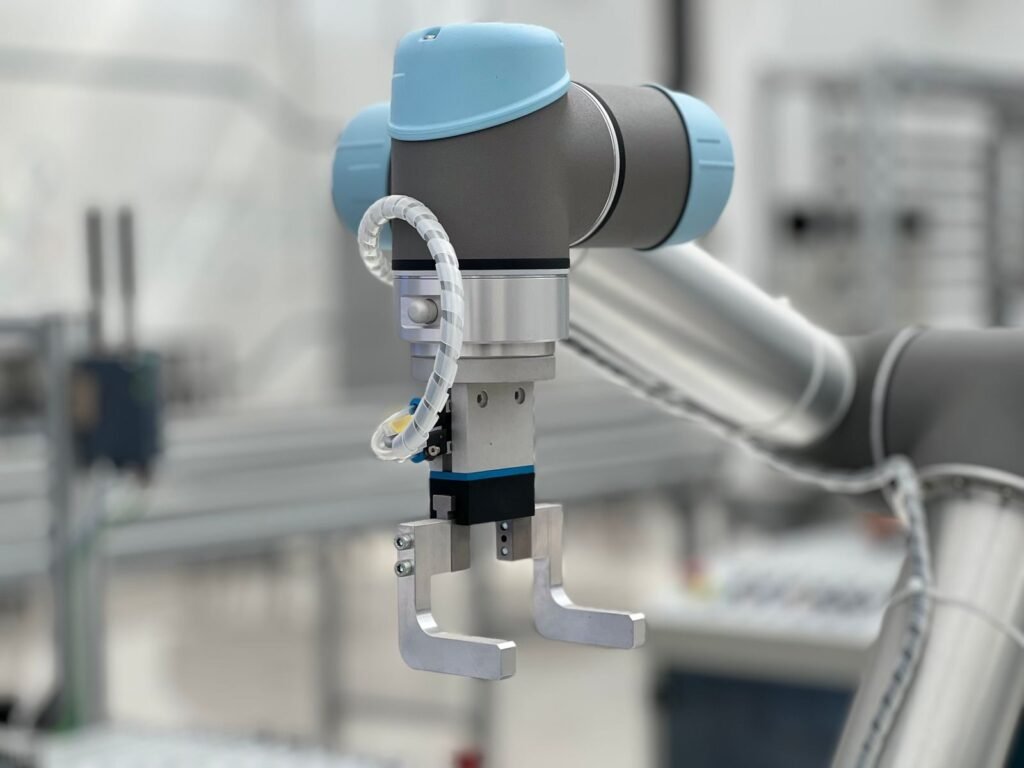
Epson has announced its first collaborative robot. The Epson AX6 is a 6-axis cobot with power- and force-limiting safety features, designed to work near people without traditional safety barriers. Epson Robots calls itself the world’s #1 SCARA robot manufacturer, with over 250,000 industrial robots sold. Now it is finally entering the cobot segment its rivals have worked for over a decade.
The launch fills an obvious gap in the lineup. It also arrives years after the market’s pioneers — and months after the AX6 itself quietly went on sale elsewhere. The context matters more than the press release suggests.
Why the Epson AX6 Is Launching in America Now
Three threads explain the timing.
A staged rollout, not a world premiere
The AX6 is not new. Seiko Epson announced its first collaborative robot in development on 3 June 2025, with launches planned for Japan and Europe first. European product pages for the AX6-A901S went live by September 2025. The 22 September 2026 announcement from Epson America is the North American leg of a phased rollout. New region, established product.
A parent pivoting away from print
Seiko Epson’s results for the year to March 2026 explain the urgency. Group revenue rose 3.7% to ¥1,413.3 billion, but operating income fell 34% and net income fell 67%. The damage came from a ¥25.9 billion goodwill impairment on Fiery, its commercial-printing software arm, blamed on market deterioration tied to U.S. tariff policy.
The Manufacturing-related & Wearable segment, which houses robotics, moved the other way. Revenue rose 13.6% to ¥206.1 billion, and the segment swung from a ¥3.2 billion loss to ¥10.8 billion in profit. Epson’s new mid-term plan targets industrial businesses rising from 33% to 50% of revenue by 2035. The cobot is a down payment on that goal.
A market back in growth mode
Interact Analysis counts roughly 58,000 cobot shipments in 2025, up 14.5%, after a cyclical trough in 2024. It forecasts shipments nearly doubling to about 129,000 units by 2030, with revenue rising from about $1.2 billion in 2025. Price wars have stabilised, and growth is expected to re-accelerate in 2027. For a late entrant, entering after the price war cooled is arguably smarter than joining it.
The Competitive Picture the Epson AX6 Faces
Epson is very late to this party. Universal Robots created the cobot category in 2008 and still leads it. One 2026 industry estimate puts its 2025 revenue share at about 31%, down from 38% in 2022. FANUC’s CRX series holds roughly 18% and is growing fastest among incumbents. ABB’s GoFa and SWIFTI hold about 12%, KUKA about 8%, Techman about 7%, and Doosan about 5%.
The harder competition is Chinese. Brands like AUBO, JAKA, Elephant Robotics, DOBOT and Flexiv collectively hold about 11% of revenue and are growing around 48% a year. Their pricing runs 35–50% below Western equivalents, with some base models under $15,000. China itself accounts for 55% of global cobot shipments, headed for roughly 61% by 2030. The Americas’ share is sliding toward 14%.
On raw specs, the Epson AX6 competes directly with the best-selling cobot class. It lifts 6 kg with 900 mm reach, versus the popular UR5e’s 5 kg and 850 mm. It weighs about 17 kg in carbon fibre, and Epson claims class-leading lightness. Its ±0.03 mm repeatability matches premium rivals.
What Epson lacks is an ecosystem. Universal Robots sells into a network of over 400 certified peripheral partners — the closest thing robotics has to an app store. A late entrant must beat that on hardware, price or both.
What the Data Shows About the Epson AX6
The specification sheet rewards a close read.
The genuine differentiators
Two specs stand out. First, the cleanroom rating: the AX6 meets ISO 14644-1 Class 5, making it suitable for pharmaceutical and laboratory automation — exactly the sectors Epson’s 2025 development announcement targeted. Most general-purpose cobots are not cleanroom-rated.
Second, mobility: the controller weighs just 6 kg and accepts 48 V DC power, so the system can ride on an autonomous mobile robot. That suits it to logistics and lab-transport work. ROS 2 and Python support round out a credible developer story.
The missing numbers
The release omits the three figures buyers ask for first: payload, reach and price. Payload and reach appear only on Epson’s European spec sheets. Price appears nowhere.
The UR5e class sells for roughly $30,000, and Chinese rivals undercut that by thousands. Until Epson publishes U.S. pricing, the value question stays open. The “over 250,000 units sold” figure is Epson’s internal data and covers decades of SCARA and 6-axis industrial robots, not cobots.
A safety certification worth noting
The AX6 carries certification to ISO 10218-1 as revised in 2025 — the year the flagship robot-safety standard was overhauled — along with ISO/TS 15066 and ISO 13849-1. Its safety functions include power and force limiting, safe stop and safe-limited speed. Cage-free operation still requires a risk assessment, as the release honestly notes. Buyers in regulated industries should verify the 2025-standard certification applies to their shipments.
What’s New vs. What’s Repackaged
New to this release: North American availability, and the “complete portfolio of robotic safety tools” framing. Not new: the robot itself, shipped in Japan and Europe since 2025; the AX Series 6-axis line, which existed before; no-code programming, now table stakes across the category; and the Python-plus-blocks development model, which FANUC, Techman and others already offer. Even the target markets echo Epson’s own 2025 announcement about laboratory automation. The portfolio logic — industrial robots, cobots, and hybrids in between — is a positioning story more than a product one.
The Question the Press Release Doesn’t Answer
What does an automation buyer pay, and what do they get for it? The release never says.
It also skips deployment costs, integrator availability and the size of Epson’s cobot-specific accessory ecosystem. Epson’s famous 250,000-unit installed base belongs to its industrial robots; a cobot customer needs cobot grippers, vision partners and local support. None of that is quantified. The reader is told a portfolio is complete, without being told what completing it costs.
What the Epson AX6 Means for You
If you automate electronics, lab or pharma lines, the cleanroom rating and 17 kg weight are real advantages over mainstream cobots. Ask Epson for the ISO Class 5 documentation and a U.S. reference deployment before committing.
If you are comparing cobots on price, wait for U.S. list pricing and integrator quotes. The UR5e class is a known quantity with a mature ecosystem; Chinese brands undercut both. The AX6’s case must rest on precision and cleanroom fit, not price.
If you follow Epson, the cobot is the visible edge of a structural shift. The parent company wants half its revenue from industrial businesses by 2035, and robotics is its fastest-improving segment. Watch whether the AX6 wins outside Epson’s traditional electronics customer base.
Editor’s Note
This article draws on Epson America’s press release of 22 September 2026, Seiko Epson’s June 2025 cobot development announcement, Epson Europe’s AX6 technical documentation, Seiko Epson’s results for the year ended March 2026, and cobot market reporting from Interact Analysis and industry estimates of brand market share. Market-share and shipment figures are analyst estimates and vary by methodology. Nothing here is investment advice.