
A battery maker backed by CATL wants German factories to know they can go greener without rebuilding anything. On 20 September, Contemporary Nebula Technology Energy (CNTE) announced an industrial battery storage system at a factory in Schwabmünchen, Bavaria. Seven liquid-cooled units now orchestrate the site’s solar array, diesel generator and grid connection.
The pitch: retrofit, don’t rebuild. The proof: roughly €27,000 a year in potential savings — “based on project assumptions”. Here is what the release says, what the market context shows, and what nobody asked.
What the Industrial Battery Storage Release Says
The system
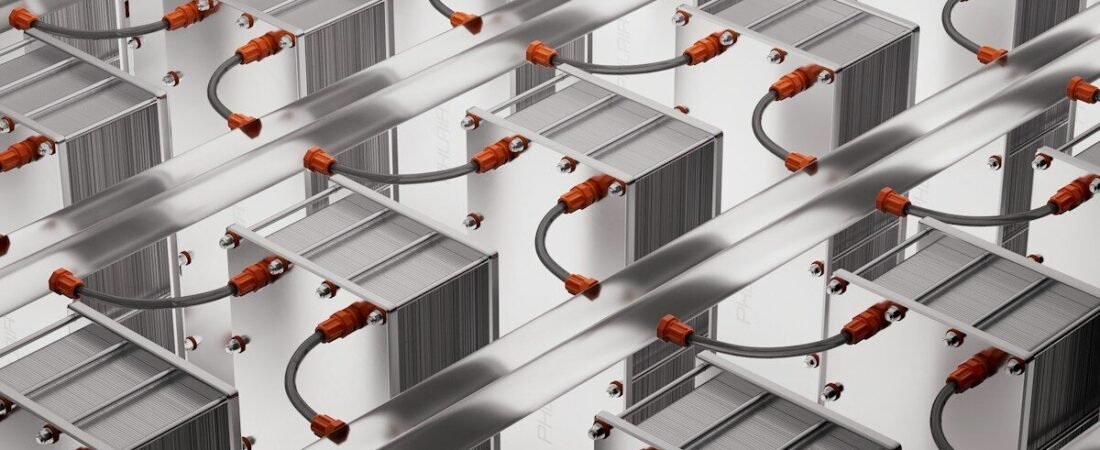
CNTE installed seven STAR-H units, each rated 100kW/232kWh, in liquid-cooled cabinets. Its Energy Management System orchestrates four energy sources: solar generation, battery storage, grid power and the diesel generator. The problems addressed: unused surplus solar, inefficient low-load diesel running, high fuel and maintenance costs, and production continuity.
The claimed benefits
CNTE quantifies three outcomes. The battery lifts solar self-consumption, storing midday surplus for evening use. That yields an estimated €27,000 in additional annual energy-cost savings, alongside about 449MWh of annual solar generation. In a representative two-hour outage, the battery would save roughly 254 litres of diesel — about €570 in fuel. Every figure is a projection, and the release says so: the savings are “based on project assumptions”, not measurements.
The Company Behind the Project
Huang Shilin founded the company in Fuzhou, China, in 2019. He is a CATL co-founder, its former vice chairman and CEO, and still its second-largest shareholder. CATL itself holds roughly a 20% stake. Huang left CATL’s executive roles in 2022. CNTE became his separately branded vehicle for storage, charging and inspection businesses.
The structure serves CATL’s diplomacy. CNTE buys CATL’s lithium iron phosphate cells and integrates them into finished systems. Meanwhile CATL keeps supplying cells to rival integrators such as Tesla, Sungrow and Fluence. CNTE claims 12 GWh of annual production capacity and more than 300 R&D engineers.
Europe is its current push. The company signed a 500MWh project agreement in Germany and opened a European service center in 2025. In August it delivered the Czech Republic’s largest battery system: 37.95MW/41.7MWh at the Modlany Energy Park. The Schwabmünchen release is the small sibling of that story — a sales brochure for Germany’s mid-size industrial segment.
The Market Behind the Industrial Battery Storage Boom
The retrofit pitch lands on fertile ground. Germany added 136MW/259MWh of commercial and industrial storage in the first half of 2026, a 33% rise year on year. The cumulative base now stands near 837MW/1,608MWh. Systems sized 100kWh to 1,000kWh — the STAR-H bracket — grew 64% year on year in early 2026. No size class grew faster.
The economics drive it. German industrial customers pay €0.18-0.28 per kilowatt-hour with all levies included, among the highest rates in Europe. The grid recorded 573 hours of negative electricity prices in 2025, up a quarter from the prior year. Midday solar floods the market. Battery prices have fallen from over €400 per kWh installed in 2022 to roughly €280-350 today.
Typical German industrial battery storage payback runs 3.5 to 4.5 years — for systems that stack peak-shaving and self-consumption properly. That last clause carries the weight, as the next section shows.
The Math the Release Doesn’t Run
Start with what a 1,624kWh commercial battery system costs in Germany. At typical behind-the-meter prices of €350-450 per kWh, the battery represents roughly €570,000 to €730,000 of capital.
Now the revenue. The release offers €27,000 a year in additional savings, plus €570 of diesel per two-hour outage. Even a factory suffering ten outages a year earns under €6,000 from the diesel line. Simple payback on the stated numbers: more than two decades.
Compare that with the 3.5-4.5-year benchmark for well-structured German storage. The gap is not subtle — it is a factor of five. Something must fill it.
The candidates are known: peak-shaving on demand charges of €5-15 per kW per month, or grid-services revenue from frequency regulation. There is also network-fee avoidance under Section 118(6) of the Energy Industry Act. That provision exempts storage commissioned before August 2029 from grid-usage fees for twenty years.
The release mentions none of them. Without disclosed cost or measured performance, the case cannot be closed either way.
The Questions Nobody Asked
Who is the customer? The factory is unnamed, its sector undisclosed, its baseline consumption unstated. A case study without a case.
What did the system cost? No figure appears. Every economic claim in the release hangs on a number the company withheld.
What are the assumptions? The €27,000 saving rests on unstated tariffs, irradiance and load profiles. It cannot be checked.
Where is the grid-revenue stacking? German paybacks come from peak-shaving and frequency services. Their absence from the release is either an omission or an admission.
What happens after August 2029? The regulator is phasing out storage grid-fee exemptions. The next retrofit buyer faces different math.
Is one 700kW site newsworthy? CNTE delivered a 41.7MWh Czech system a month earlier. A 1.6MWh site is a press release, not a milestone.
New vs Repackaged: What the Release Delivers
New — the deployment and the segment focus. A CATL-linked integrator is selling liquid-cooled retrofits into German mid-size industry. The Schwabmünchen system is a working reference.
Repackaged — the concept. Coordinating solar, battery, diesel and grid through an EMS is the industry’s standard architecture. “Don’t tear out your existing assets” is every vendor’s pitch, not a breakthrough.
Missing — the economics. Cost, measured results, customer identity and payback are all absent. What remains is a capabilities brochure with projections in place of numbers.
What Industrial Battery Storage Means for You
If you operate a factory with solar and backup generation, the industrial battery storage retrofit model is genuinely sound. Germany’s price spreads and negative-price hours reward it. Demand a measured baseline, a peak-shaving analysis and explicit grid-revenue modelling before signing. Time the connection: systems commissioned before August 2029 lock in twenty years of grid-fee exemptions.
If you compete in storage integration, the battleground is the 100kWh-1MWh liquid-cooled bracket. That bracket is growing 64% a year, and Chinese cell-backed entrants are pricing aggressively.
If you watch the supply chain, note the pattern. CATL sells cells to every major integrator while quietly holding a fifth of one of them. The Schwabmünchen release is that strategy at factory scale.
Editor’s Note
This article draws on the CNTE press release of 20 September 2026, distributed by PR Newswire. Facts used: system specifications, claimed savings, project description and company description.
Verified from public sources: CNTE‘s founding, leadership, ownership structure and production capacity come from the company’s website and ENF Solar. Energy-Storage.News (4 August 2026) and third-party industry research fill out the record. The Czech Republic project details come from Energy-Storage.News. German C&I market figures come from industry trackers: mate-solar, SolarPower Europe via zvepow, and IndexBox, covering 2025 and H1 2026.
The grid-fee exemption and its phase-out come from the Energy Industry Act (Section 118(6) EnWG) and Bundesnetzagentur reform reporting. Payback benchmarks come from Dongwu Securities reference cases as cited in European C&I storage market analyses.
Company-reported and unverified: all Schwabmünchen project figures are projections “based on project assumptions”. That covers the €27,000 annual saving, the 449MWh solar generation, the 254-litre diesel saving and the outage scenario. None of them carries a disclosed methodology, cost or measured baseline. The implied system cost of €570,000-730,000 is an estimate from typical market prices, not a disclosed figure.