
India’s telecom regulator now forces caller-ID apps to hand their users’ spam reports to telecom operators. The TRAI spam rules, finalised on 18 September, require such apps to pipe users’ reports into telcos’ blockchain platform. An app that refuses must drop the feature entirely. Truecaller, with over 350 million Indian users, calls the mandate a “one-way exchange” that is “anti-competitive”. Here is what the rules say, what the record shows, and what nobody asked — robocalls included.
What the TRAI Spam Rules Say
The data-sharing mandate
The amendment to the Telecom Commercial Communications Customer Preference Regulations, 2018 finalises a draft issued in March. Any app offering spam or junk reporting must route those reports to telcos’ Distributed Ledger Technology (DLT) platform. An app that refuses loses the right to offer the reporting feature at all. TRAI says the change widens the pool of reports available for action against spammers.
The blanket-block ban
The rules also bar apps from blanket blocking, filtering or tagging calls from designated number series. The 1600xx and 1601xx series carry service and transactional calls; the 140xx series carries regulated promotional calls. A 1600-series call cannot be blocked at all. Apps can block a 140-series call only if the user opted out of that sector on the DND registry. Individuals can still block any call on their own devices.
The robocall regime
The amendment defines Application-to-Person calls: software-initiated calls without direct human dialling. That covers autodialed calls, robocalls and pre-recorded or artificial voices. Businesses using them must declare that use, and the numbers involved, to their telecom operator in advance.
Undeclared A2P calls count as spam. Operators can also levy a termination charge of up to 5 paise per minute on compliant A2P traffic. Receiving operators must flag suspected spam numbers and share them with the sending operator within two hours. Three or more unique complaints against a number within ten days now trigger action. Consumers get a fifteen-day appeal window against wrongly closed complaints.
The Company in the Crosshairs
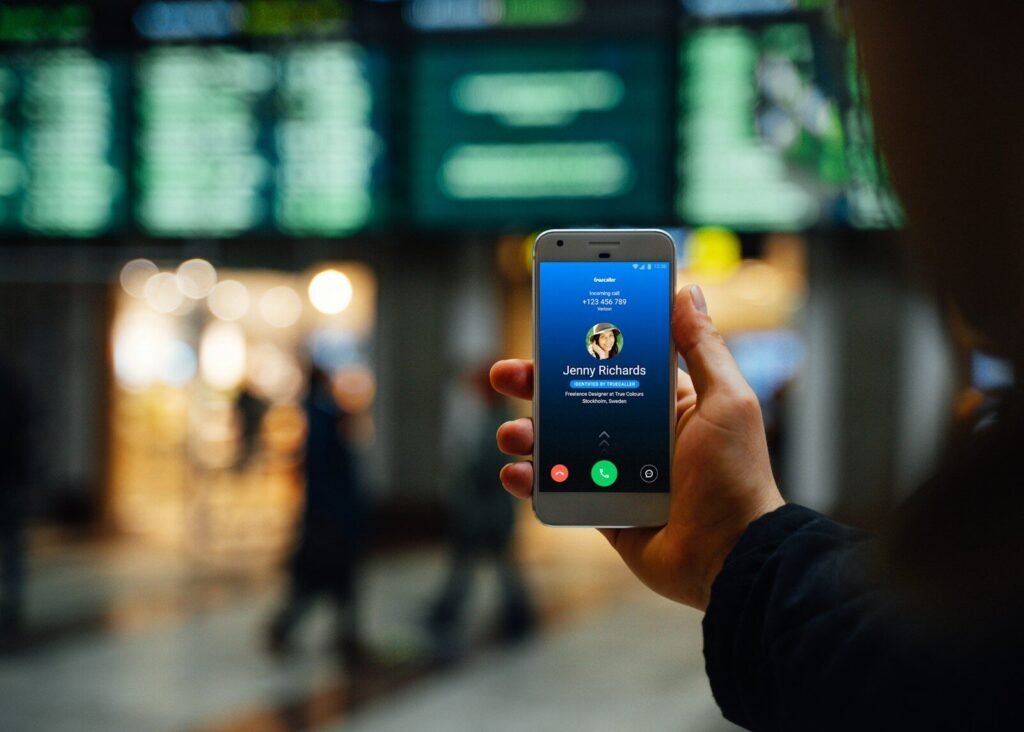
Truecaller is a Stockholm-listed caller-ID app with more than 500 million monthly active users. Over 350 million of them are in India — roughly 70% of its base, and its largest market by far. Its moat is crowdsourced data: community reports, automated detection and signals from hundreds of millions of devices.
The company’s own numbers describe the problem it polices. Its 2025 India report counted 41.68 billion spam calls encountered and 129 billion spam messages. Truecaller blocked 11.89 billion of those calls. India ranked fifth globally for spam intensity, with two-thirds of unknown calls flagged as spam.
Revenue tells a separate story. India net sales fell 3% in 2025 to about SEK 1,310 million — roughly two-thirds of the company’s total.
The friction predates Friday. In July, CEO Rishit Jhunjhunwala publicly fought TRAI over the series-tagging ban. His internal data: users ignore 81% of 1400-series calls and 79% of 1600-series calls. Users also manually blocked 74 million calls from those series in eight months.
TRAI had reportedly sought powers under the IT Act to act against Truecaller, Hiya and Whoscall. Truecaller says it has complied with the reporting requirement since late last year. It argues spam has “skyrocketed due to this free pass to spammers”.
The Platform Getting the Data
The destination for those reports has a six-year track record. TRAI mandated the DLT platform in its 2018 regulations, a world-first use of permissioned blockchain as regulatory technology. Telcos registered headers, templates and consent on it, and scrubbed traffic against preference registries. The rollout cut registered SMS headers from roughly 900,000 in 2018 to 600,000 in 2022. It also killed lookalike headers imitating SBI, Uber and Amazon.
It also broke things. When template filtering went live in March 2021, about 370 million messages failed in a day. The casualties included bank OTPs, Aadhaar authentication and CoWIN vaccination codes.
Enforcement has nonetheless scaled. TRAI issued 731,120 notices to unregistered telemarketers in 2025 and disconnected 184,482 resources. Operators have cut more than 21 lakh numbers since August 2024. Chairman A.K. Lahoti claims complaints have fallen to one per crore of calls and messages.
The TRAI spam rules now route crowdsourced intelligence into this same machinery. Truecaller’s users have spent two years working around its series designations.
Why the TRAI Spam Rules Are a Three-Front Squeeze
Front one: data. Apps must hand over the reports that power their detection. Nothing flows back — no telco AI flags, no DLT data. Truecaller calls it a one-way exchange; on the face of the regulation, it is.
Front two: product. The blanket-block ban restricts how apps can label entire series, even when most calls from those series go ignored.
Front three: competition. The Department of Telecommunications is rolling out CNAP: caller name display drawn from KYC records, on by default. Operators including Airtel, Jio and Vi have already trialled it in Haryana. TRAI’s chairman has said caller names “cannot be crowdsourced”, a direct dismissal of the Truecaller model. Truecaller’s own earnings flag “increased competition from more limited telco solutions like Business CNAP in India”.
A regulator that restricts your labelling, requisitions your data and funds a rival is not just regulating an app. It is redistributing a data advantage.
The Questions Nobody Is Asking
The TRAI spam rules leave at least six questions open.
What exactly must be shared? Analyst Kazim Rizvi draws the line. A specific user report is one thing; reputation signals and analytical systems are another. The regulation does not say which it wants.
Where is user consent? Nobody has explained how users will be notified. Retention and downstream use of reports remain unspecified.
Do Google and Apple count? TRAI left unanswered whether Android and iOS dialer spam features fall under the mandate.
What teeth remain? The March draft threatened non-compliant apps with loss of IT-Act safe harbour. The final text says only that TRAI may act “under the applicable laws”, after hearing the entity. The strongest enforcement hook is gone.
Why trust the pipeline? A platform that failed 370 million messages in a day is now the compulsory destination. Its consent module never shipped.
Why is crowdsourced data good enough to requisition but not to display? TRAI’s CNAP reasoning rejects crowdsourced identity as unreliable. These rules treat it as enforcement-grade evidence.
New vs Repackaged: What the Amendment Delivers
New — the app obligations. Data-sharing and blanket-block bans for call-management apps enter the regulations for the first time. So do the A2P definition, the 5-paise termination charge and the consumer appeal window.
Repackaged — the rest. The series-tagging restrictions were already in force through a July clarification. The AI/ML detection direction dates to February. The DLT platform and its enforcement escalations go back years.
Missing — the details. No notification date, no data specification, no word on OS dialers, no consent mechanics.
What the TRAI Spam Rules Mean for You
If you run a business that uses automated calls, the rules give you a choice. Declare your A2P numbers, or your traffic counts as spam — with charges attached. Budget for the termination fee before scaling voice campaigns.
If you build apps on top of telecom networks, read this as precedent. A regulator can now condition your product features on handing data to network operators.
If you are a consumer, expect more state-verified caller identity and fewer app-driven labels on designated series. Your individual reports now carry regulatory weight: three complaints in ten days can trigger action against a number.
Editor’s Note
This article draws on TRAI’s press release of 18 September 2026 (PR No 119 of 2026) and PTI’s reporting of the same day. TechCrunch (18 September, 8 July, 26 April 2026) and MediaNama (19 September) fill out the record.
Truecaller‘s user numbers and financials come from its Q4 2025 year-end report on Nasdaq Stockholm. Its India spam statistics come from its Insights Report 2025, as covered by WION and India TV.
TRAI’s enforcement figures come from its UTM enforcement metrics release (PR No 20 of 2026). The chairman’s February 2026 statements to Moneycontrol supply the complaint-rate claims. The DLT platform history comes from TRAI documents and The Economic Times. CNAP details come from TRAI’s February 2024 recommendations, the October 2025 TRAI-DoT exchange, and The Hindu.
Company-reported and unverified: Truecaller’s spam counts, block rates and the “one-way exchange” characterisation. TRAI’s complaint-rate claims are also its own. The regulations were finalised on 18 September but had not been notified at the time of writing. Enforcement timelines begin only after notification.