
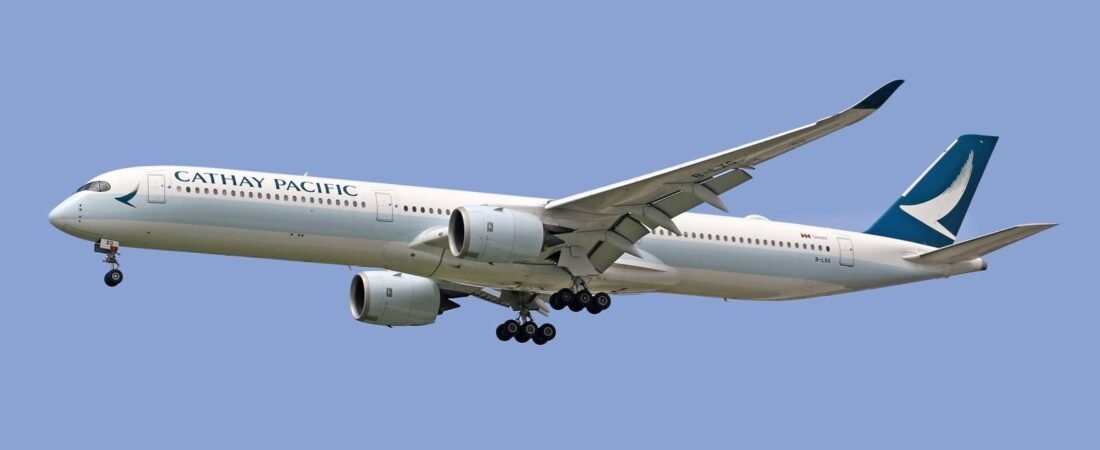
Cathay Pacific and Google announced a partnership on September 7, 2026, to research and trial AI-powered contrail avoidance technology across the airline’s global network. Cathay Pacific is Google’s first commercial airline partner in Asia-Pacific for this technology, and the first airline globally to test contrail avoidance on ultra-long-haul flights.
Over 80 trial flights using AI-guided altitude adjustments achieved an estimated 40% reduction in contrail warming impact. The partnership is now expanding to a larger second phase across Asian and transpacific routes, with Contrails.org as a nonprofit partner.
The press release is rich in feature description but silent on competitive context, fuel impact, and how these results compare to Google’s earlier trials with American Airlines. What follows is what the release does not say.
What the Cathay Pacific Google AI Contrail Partnership Includes
Google’s contrail mitigation solution combines AI-based predictive models, satellite imagery detection tools, and weather intelligence to forecast contrail-forming zones. Pilots and dispatchers use this data to make altitude adjustments, navigating around these zones much like they avoid turbulence.
Cathay Pacific connects these forecasts to the cockpit through in-flight Wi-Fi and its proprietary Electronic Flight Folder (EFF). The EFF system equips pilots with dynamic Google contrail forecasts alongside real-time operational parameters. This enables decision-making without disrupting normal cockpit operations.
An operational trial began in late 2025, targeting more than 100 flights across Cathay Pacific’s network. Over 80 flights followed contrail-avoidance routes. Google estimates these flights achieved roughly 40% reduction in the warming impact of contrails.
The Hong Kong-Singapore corridor was one tested route, as flights there frequently encounter conditions where persistent contrails form. Actions on this single route accounted for more than 50% of the trial’s total climate benefit.
Layer 1 — Why Now: Aviation’s Non-CO2 Climate Problem
Contrails are clouds that form when aircraft fly through cold, humid conditions at high altitude. Many disappear quickly. Some persist and spread into broader cloud formations that trap heat in the atmosphere. Previous research suggests persistent contrails could account for around one-third of aviation’s total climate impact.
The Science Is Now Clear
A January 2026 study in Nature Communications projected that without contrail avoidance, aviation will contribute 0.054 K of contrail warming by 2050. That is 136% of the projected CO2 warming from aviation in the same year. The study found that an avoidance strategy phased in over 2035-2045 could recover 9% of the remaining temperature budget under the Paris Agreement.
A separate 2024 study in Atmospheric Chemistry and Physics found that just 2% of all flights cause 80% of annual contrail energy forcing. Contrails.org’s Impact Explorer analyzed 29.9 million commercial flights in 2025 and found that only 3% of flight kilometers generated warming contrails. That translates to 196.8 million tonnes of CO2-equivalent warming. Adjusting just 2,285 flights per day could address 80% of contrail warming.
The Regulatory Clock Is Ticking
The European Union now requires airlines to report their non-CO2 climate impact starting in 2025. By 2028, the European Commission aims to propose legislation to mitigate non-CO2 aviation effects. This regulatory timeline creates urgency for airlines to develop operational contrail avoidance capabilities.
Cathay Pacific’s Financial Context
Cathay Pacific announced its 2026 interim results on August 5, 2026 — one month before this announcement. Revenue reached HK$68.1 billion, up 25.3% year-over-year. Attributable profit was HK$6.2 billion, up 71% from HK$3.7 billion in the first half of 2025. Cathay Pacific carried 16 million passengers in the first half of 2026, 17.5% more than the same period in 2025.
Cathay has committed approximately HK$150 billion in investments across fleet, cabin, lounge, and digital innovation. The airline targets 150 new aircraft and 150 destinations in the next 10 years. This financial strength provides the runway for sustainability investments like contrail avoidance.
Layer 2 — Competitive Positioning: Google’s Growing Airline Roster
Cathay Pacific is not Google’s first airline partner. It is the latest in a series of expanding trials.
American Airlines: The Original Partner
Google’s contrail avoidance work began with American Airlines in 2023. American pilots flew 70 test flights using AI-based predictions, achieving a 54% reduction in contrail formation. Fuel impact was approximately 2% per flight, translating to 0.3% across an entire fleet.
In early 2025, American Airlines and Google conducted a much larger trial. Over 17 weeks, contrail forecasts were integrated into the airline’s flight planning software for 2,400 transatlantic flights. Results published in March 2026 showed a 62% reduction in contrail formation for per-protocol flights. No statistically significant increase in fuel usage was observed. This study was published in the journal JECATS and co-authored by researchers from Google, American Airlines, Flightkeys, Contrails.org, and Imperial College London.
Other Airlines and Initiatives
KLM worked with SATAVIA on contrail prevention trials from 2022 to 2023, conducting operational trials across European routes. Delta Air Lines collaborated with MIT on a tactical contrail avoidance tool. Delta became the first airline to set contrail reduction targets in 2023 — 80% reduction by 2035 and 100% by 2050 — though Blue Lines reports these targets have not been reiterated by Delta’s new sustainability leadership.
Lufthansa partnered with DLR on the German “100 Flights” initiative, combining forecasting with airline dispatch changes and air traffic control altitude clearances. SATAVIA ran a 10-month multi-airline demonstrator across 12 airlines, including Icelandair, Kenya Airways, Condor, and KLM.
Operation Blue Skies: Airspace-Scale Trial
On August 18, 2026 — three weeks before the Cathay announcement — Google launched Operation Blue Skies with the UK Government and NATS. This is the world’s first state-backed trial to avoid contrails at the scale of an entire oceanic airspace. The 30-month program covers Shanwick airspace in the eastern North Atlantic, which accounts for approximately 5% of global contrail warming. Around 10,000 flights pass through this airspace during trial hours each year.
Google UK is participating on a pro-bono basis, contributing £1.4 million in-kind. Partners include NATS, Contrails.org, Imperial College London, University of Cambridge, and the UK Met Office.
Where Cathay Pacific Fits
Cathay Pacific brings two genuine firsts: Google’s first APAC commercial airline partner, and the first airline globally to test contrail avoidance on ultra-long-haul flights. The APAC geography has been underrepresented in previous trials, as noted in the press release. A 2024 study found that contrail radiative forcing over East Asia (64 mW/m2) and China (62 mW/m2) is close to the global average, partly because fewer flights in these regions form persistent contrails due to lower cruise altitudes and limited ice supersaturated regions in the subtropics.
Layer 3 — Public-Data Sweep: Cathay’s Emissions Trajectory
Cathay Pacific’s own sustainability disclosures provide context the press release omits.
GHG Emissions Are Rising
Cathay Pacific’s 2025 annual results disclosed GHG emissions of 15.3 million tonnes of CO2-equivalent, up 19.5% from 12.8 million tonnes in 2024. GHG emissions per available tonne kilometer worsened slightly, rising from 517 grammes of CO2e in 2024 to 532 grammes in 2025 — a 2.9% increase in emissions intensity.
This means Cathay’s emissions are growing faster than its operational efficiency is improving. Revenue grew 11.9% in 2025 while GHG emissions grew 19.5%. The airline is growing, but its carbon footprint is growing faster.
SAF Investments
Cathay has made notable SAF investments. The airline joined as a launch investor in the US$150 million oneworld Breakthrough Energy Ventures Fund. Cathay committed up to US$70 million in a SAF co-investment partnership with Airbus. The Cathay Corporate SAF Programme saw partners commit to 17,400 tonnes of SAF in 2025, up 180% from 2024. A renewed DHL Express partnership commits to over 13,440 tonnes of SAF for 2026 — four times the 2025 amount.
These are meaningful investments, but SAF addresses CO2 emissions. Contrail avoidance addresses non-CO2 climate impact — a different problem requiring a different solution.
The 40% vs. 62% Gap
Cathay Pacific’s 40% reduction in contrail warming impact is lower than American Airlines’ results. American achieved 54% in 2023 and 62% in 2025. Several factors could explain this gap. Cathay’s trial covered ultra-long-haul flights in APAC, a different operational environment from American’s transatlantic routes.
Weather patterns, air traffic density, and airspace constraints differ across regions. The press release does not address why results are lower.
Contrails.org’s Cost Estimates
Contrails.org estimates that contrail avoidance costs approximately $1.75 per tonne of CO2-equivalent warming avoided. Their analysis projects $732 million per year in additional fuel costs for global contrail avoidance. Even in pessimistic scenarios ($14 per tonne CO2e), this remains a fraction of most other climate solutions. The press release does not mention cost.
Layer 4 — The Unasked Question: What About Fuel Burn?
The press release does not mention fuel consumption impact. This is the single most important operational question for any airline considering contrail avoidance.
Google’s Previous Fuel Data
Google’s 2023 trial with American Airlines showed a 2% fuel increase per contrail-avoidance flight, translating to 0.3% across an entire fleet. The 2025 American Airlines trial found no statistically significant difference in fuel usage between the treatment and control groups. This was a significant finding — contrail avoidance without fuel penalty makes the intervention nearly cost-free.
The Cathay Pacific Google AI contrail trial does not disclose whether fuel burn increased, decreased, or remained unchanged. The footnote in the press release notes that not all 100+ flights participated “due to factors including airspace and payload restrictions.” These operational constraints directly affect fuel calculations.
Why Fuel Matters
Airlines operate on thin margins. Even a 0.3% fleet-wide fuel increase has cost implications. If contrail avoidance increases fuel burn, the CO2 savings from avoided contrails must be weighed against additional CO2 from extra fuel. Google’s research suggests the reduction in contrail warming is 20 times greater than the additional CO2 from fuel burned — but this ratio depends on specific flights and atmospheric conditions.
The Missing Comparison
The press release does not compare Cathay’s results to American Airlines’ results. American achieved 54% in 2023 and 62% in 2025. Cathay achieved 40%. The press release frames 40% as “encouraging early results” without contextualizing it against Google’s own prior benchmarks.
Layer 5 — Honest Translation: What the Claims Mean
“First commercial airline partner in Asia-Pacific”
True. Google’s previous airline partnerships were with American Airlines (North America) and trials with European airlines. Cathay Pacific is the first APAC partner. This is a genuine regional first.
“First airline globally to test contrail avoidance on ultra-long-haul flights”
True and genuinely distinctive. Previous trials focused on transatlantic and European regional routes. Ultra-long-haul flights present different operational challenges — extended time at cruise altitude, varying atmospheric conditions across multiple climate zones, and different fuel-weight considerations.
“40% reduction in contrail warming impact”
This is Google’s estimate, not independently verified. Methodology uses satellite imagery analysis. A 40% figure is lower than American Airlines’ 54% (2023) and 62% (2025) results. Press release does not explain the gap.
“Over 80 flights followed contrail-avoidance routes”
The trial targeted more than 100 flights. Over 80 participated. Approximately 20% of targeted flights did not follow contrail-avoidance routes. The footnote attributes this to “airspace and payload restrictions.” This participation rate is important for understanding operational feasibility.
“More than 50% of the trial’s total climate benefit from Hong Kong-Singapore corridor”
This concentration is notable. It suggests that a small number of high-traffic routes may account for most of the climate benefit. Contrails.org’s data confirms this pattern globally — 80% of contrail warming comes from 3% of flights.
Layer 6 — Decision-Maker Framing: Who Should Care
For Airlines
Contrail avoidance is emerging as one of the most cost-effective climate interventions available. At approximately $1.75 per tonne CO2e avoided, it is cheaper than SAF, carbon offsets, or most other aviation decarbonization pathways. The technology is proven — Google’s American Airlines trial demonstrated 62% reduction with no fuel penalty. Cathay Pacific’s trial extends the proof to APAC and ultra-long-haul operations.
But ask about fuel burn. The press release does not disclose this data. Ask about operational constraints — 20% of targeted flights could not participate. Ask about scaling — can this work across an entire fleet, not just select routes?
For Cathay Pacific Investors
Cathay’s GHG emissions grew 19.5% in 2025 while revenue grew 11.9%. Emissions intensity worsened by 2.9%. The airline is profitable and growing, but its carbon footprint is expanding faster than its business.
Watch for fuel burn data in the second phase. If Cathay replicates American Airlines’ result of no significant fuel penalty, contrail avoidance becomes a near-free climate intervention. If fuel burn increases, the cost-benefit calculus changes.
For Climate Policymakers
The EU’s 2025 non-CO2 reporting requirement and 2028 mitigation legislation create a regulatory framework that will force airlines to address contrails. Google’s expanding partnership network — American Airlines, Cathay Pacific Google AI contrail trials, EUROCONTROL MUAC, Operation Blue Skies — demonstrates that the technology is maturing from trial to operational deployment.
The key question is whether contrail avoidance can scale from individual airline trials to airspace-wide implementation. Operation Blue Skies, launching in 2026, will test this at the scale of an entire oceanic airspace.
For the Aviation Industry
Contrails cause 1-2% of all human-caused warming. Adjusting 5% of flights could avoid up to 80% of contrail warming. The cost is approximately $1.75 per tonne CO2e — making it one of the cheapest climate solutions available.
The Cathay Pacific Google AI contrail trial contributes the first APAC data point. A 40% reduction, while lower than American Airlines’ results, confirms that contrail avoidance works across different geographies and flight types. The second phase will generate broader data across Asia and transpacific routes.
What Is Genuinely New vs. What Is Established
Genuinely New
Cathay Pacific is Google’s first APAC airline partner. It is the first airline to test contrail avoidance on ultra-long-haul flights. The APAC region has been underrepresented in contrail research. The Electronic Flight Folder integration with Google’s forecasts is a Cathay-specific implementation.
Established
Google’s AI contrail prediction technology was developed with American Airlines starting in 2023. The methodology — AI-based predictive models, satellite imagery, weather intelligence — is the same. Contrails.org was also a partner in the American Airlines trial. The concept of altitude adjustments to avoid contrails is well-established in the scientific literature.
Unclear
Fuel burn impact during Cathay’s trial. Why the 40% reduction is lower than American Airlines’ results. How many of the 100+ targeted flights were in the control group vs. treatment group. Whether the Hong Kong-Singapore corridor’s 50% contribution reflects route-specific atmospheric conditions or route selection bias. The cost per tonne CO2e for Cathay’s specific trial.
The Bigger Picture
The Cathay Pacific Google AI contrail avoidance trial is a meaningful contribution to aviation climate science. A 40% reduction, while lower than Google’s results with American Airlines, is the first data point from APAC and from ultra-long-haul operations. The second phase will determine whether the technology can scale across Cathay’s network.
But the press release leaves three questions unanswered. What was the fuel burn impact? Why is the reduction lower than American Airlines’ results? And can contrail avoidance scale from individual airline trials to industry-wide implementation?
Google’s strategy is becoming clear. Start with one airline (American Airlines, 2023), prove the concept. Scale to larger trials (American Airlines, 2025). Expand to new geographies (Cathay Pacific, 2026). Move to airspace-scale trials (Operation Blue Skies, 2026).
Each step generates data that supports the next. The destination is industry-wide contrail avoidance, embedded in standard flight planning, at near-zero cost. Whether the industry gets there depends on fuel burn data, regulatory mandates, and operational scaling.
A 40% reduction is encouraging. The unanswered questions are important. And the clock — both regulatory and climate — is ticking.
Editor’s Note
This article is based on the press release issued by Cathay Pacific and Google on September 7, 2026, and additional publicly available information including Google Research’s blog posts from March 19, 2026 and September 7, 2026, the JECATS journal study “Efficacy of Scalable Airline-led Contrail Avoidance” published April 21, 2026, AP News reporting from March 19, 2026, Aerospace Global News reporting from March 20, 2026, Google Research’s Project Contrails page, American Airlines press release from August 8, 2023, Cathay Pacific 2026 Interim Results announcement from August 5, 2026, Cathay Pacific 2025 Annual Results announcement from March 11, 2026, Cathay Pacific Sustainability Report 2025, HKEX filings for Cathay Pacific Airways Limited (Stock Code: 293).
Contrails.org website and notebook posts, Contrails.org Impact Explorer data for 2025, Blue Lines contrail avoidance trials listing, Blue Lines airline index, Simple Flying contrail research analysis from January 2024, Google blog post on Operation Blue Skies from August 18, 2026, Nature Communications study “The climate opportunities and risks of contrail avoidance” from January 28, 2026, Nature Communications study “The social costs of aviation CO2 and contrail cirrus” from September 29, 2025, Nature study “Substantial aircraft contrail formation at low soot emission levels” from April 1, 2026, Atmospheric Chemistry and Physics study “Global aviation contrail climate effects from 2019 to 2021” from May 2024, and Atmospheric Chemistry and Physics study “Improving forecasts of persistent contrails” from April 2026.
Cathay Pacific is a publicly traded company (HKEX: 293). Google is a subsidiary of Alphabet Inc. (NASDAQ: GOOGL). A 40% contrail warming reduction is Google‘s estimate based on satellite imagery analysis and has not been independently verified. Cathay Pacific’s GHG emissions of 15.3 million tonnes CO2e for 2025 are company-reported.
Contrails.org‘s cost estimate of $1.75 per tonne CO2e is an organizational projection, not a verified market price. Fuel burn impact for Cathay Pacific’s trial was not disclosed in the press release.
Contact: techrecasteditor@gmail.com