
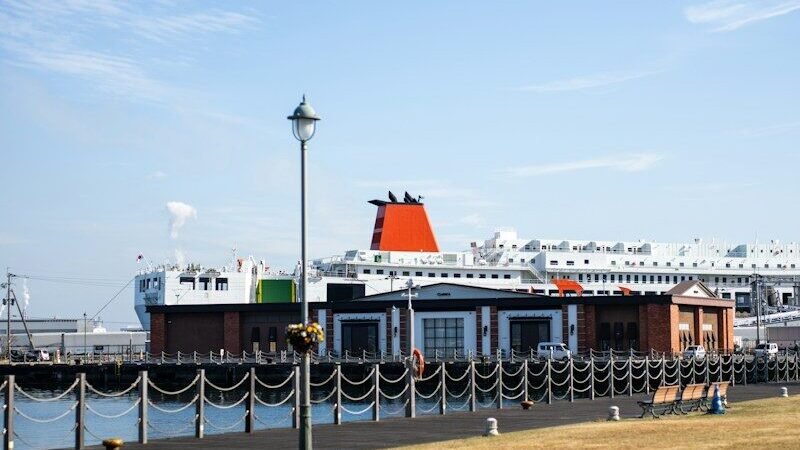
Reality Capture Goes Daily on a $78 Million Terminal Expansion
Procon Consulting has partnered with the Canaveral Port Authority to expand the use of robotic reality capture during construction at Cruise Terminal 5, following a pilot that demonstrated how a four-legged robot could document changing site conditions through repeatable 360-degree capture walks. The platform, nicknamed Sparky, provides the port and its project teams with more frequent visual documentation of progress while reducing time spent on routine site walks. The $78 million expansion and renovation will nearly double the terminal from 90,000 to 170,000 square feet to accommodate the largest cruise ships.
Teleworker AI developed components of the robot’s camera payload, and the pilot grew out of Procon’s construction robotics research with Virginia Tech’s Myers-Lawson School of Construction through an initiative called the Multi-Agent Robotic System for Inspection On Site. Procon is evaluating capture frequency, reliability and usefulness to the project team. The release gives no capture frequency, no accuracy figure, no time saved, no robot platform and no deployment cost.
The problem reality capture actually solves
Construction has an unusual documentation problem, and it is worth stating because it explains why a robot walking a site is more consequential than it sounds. A project produces an enormous amount of physical change every day and records almost none of it at the moment it happens.
The record that exists comes together later and selectively. A superintendent photographs what interests him. A monthly progress report captures a state the site has already moved past. A schedule update records what the contractor says happened. When a dispute arises months afterwards about whether a late steel delivery or a slow inspection caused a delay, the parties reconstruct the answer from documents that interested parties wrote, and the reconstruction is where the money goes.
Reality capture changes the character of that record rather than its volume. A repeatable capture walk from the same starting point produces a comparable image at each interval, which means a project team can put two dates side by side and see what changed between them. That is a different kind of evidence from a photograph, because a photograph shows a condition and a time series shows a rate.
Why a quadruped, and why daily
Two design choices in this deployment deserve examination, because each answers a specific objection.
The first is the four-legged shape. A fixed camera covers one view and cannot follow a build that moves through a building. A drone needs airspace, a pilot and reasonable weather, and it flies above the work rather than through it. A tracked or wheeled robot struggles with stairs, thresholds, cable trays and debris, which is most of what an active construction site consists of. A quadruped handles stairs and uneven ground, which is what allows it to walk the same route every day rather than a route chosen for the machine.
The second is the cadence. Monthly capture is a report. Daily capture is a record, and the difference is what it does to disputes. A question about whether a wall was complete on a particular Tuesday has a specific answer when someone captured Tuesday. That removes an entire category of argument, and the release makes the point in the quotation from Stephen DeVito, Procon’s director of technology, that on a project like this a lot can change in a single day.
The claims and change-order angle
The release states that the resulting record can help verify completed work and provide documentation if questions arise about schedule, change orders or construction claims. That sentence is doing more work than its length suggests, and it is the commercial core of the whole deployment.
Change orders and claims are where construction projects lose margin and where owners lose control of budgets. A change order is a claim that something differed from what the contract anticipated, and proving it depends on establishing what the site looked like before and after. A daily photographic record from a consistent position is close to ideal evidence for that purpose: it is contemporaneous, it is not authored by either party to the dispute, and it is comparable across time.
The effect on behaviour is worth noting separately. A site with a record for every day is a site where the record itself rarely becomes the argument, and both contractor and owner negotiate from a shared set of facts rather than competing reconstructions. That tends to shorten disputes rather than create them, which is a benefit that does not appear in any equipment budget.
From a Virginia Tech lab to an active terminal
The provenance of this deployment is more interesting than most vendor case studies, because it did not begin as a product.
The pilot grew out of Procon’s construction robotics research with Virginia Tech’s Myers-Lawson School of Construction, through an initiative called the Multi-Agent Robotic System for Inspection On Site. That name describes a research question rather than a product: how multiple robots and remote monitoring can help project teams collect and use field information. A single quadruped walking a terminal expansion is a narrow application of a broader research agenda, and the release is honest that Procon is still evaluating capture frequency, reliability and usefulness under real operating conditions.
The Teleworker AI contribution is also specific in a way worth crediting. The company developed components of the camera payload and worked on assembly and setup to prepare the robot for deployment with limited hands-on intervention. That last phrase describes the actual engineering difficulty: a research robot works when a researcher is present, and a deployed robot has to work when a site team starts it in the morning and expects it to complete a route unattended.
What the evaluation is actually testing
The release states that Procon is evaluating capture frequency, reliability and usefulness to the project team, and those three words describe a more demanding test than they appear to.
Frequency is a scheduling question with a cost attached. Every walk takes time, every dataset takes storage and every capture needs processing before anyone can look at it, so the useful cadence is the shortest interval whose cost the project can absorb. Reliability is harder: a robot that completes its route nine days out of ten is a novelty, and one that completes it every day for a year is infrastructure. Usefulness is the question that decides whether any of it matters, because a record nobody consults has no value regardless of how good it is.
That framing is unusually honest for a deployment announcement, and it points at the metric that would settle the case. The measure of a reality capture programme is not how many images it produces but how many times somebody opens the record to answer a question, and the release does not report that.
The record outlives the build
One part of the case is about the period after construction, and it is the part most owners underestimate.
Jason Lopez, senior vice president at Procon, describes the value extending beyond construction: an accurate visual record of facility conditions can help facilities teams plan maintenance, troubleshoot issues and coordinate repairs. That is a real asset and it is usually lost. A terminal handed over with a set of as-built drawings and a maintenance manual has no visual record of what sits behind the wall, and every subsequent repair begins with discovery.
A daily capture series from construction produces, as a by-product, a four-dimensional record of where everything is. For a 170,000 square foot terminal that will operate for decades and carry nine million passenger movements a year, that record earns its keep every time someone needs to locate a system, a warranty question arises, or a renovation is planned. The construction project pays for it and the facility management function benefits, which is an unusual alignment of incentives.
What would make this reality capture a specification rather than a demonstration
The gap between this release and a document a project team could evaluate is wide, and five additions would close it.
Capture frequency is the first, and the release names it as one of the things still under evaluation. Whether Sparky walks daily, twice weekly or weekly determines whether the record answers the Tuesday question or only the month question.
Accuracy and resolution are the second. A capture someone can measure to a tolerance is a survey; one they cannot is a photograph. Which of those this is decides whether the record can support a dimensional claim or only a visual one.
Time saved is the third, and it is the number that justifies the cost. The release says routine site walks take less time, which is credible and unquantified. Hours saved per week across a project team is the figure a construction manager needs.
The robot platform is the fourth. The release describes a four-legged robot without naming it, which is a reasonable omission in a customer announcement and an odd one in a technology story.
And the cost is the fifth, including whether this is a service Procon provides or equipment the port operates. That determines whether the model scales to smaller projects or stays confined to flagships.
What to watch
Whether Procon publishes the evaluation findings, because capture frequency, reliability and usefulness under real conditions are exactly the questions the sector needs answered and almost nobody publishes the answers. Whether the daily record is used in an actual claim or change order, since the first time it settles a dispute is the moment the case for the technology becomes undeniable. And whether the port retains the record for facility management after handover, because that is the benefit with the longest tail. And whether the model reaches projects smaller than a $78 million terminal, because a technology that only works on flagship builds is a demonstration and one that works on a routine renovation is a product.