
Proofpoint has agreed to acquire Varonis Systems in an all-cash transaction valued at approximately $6.3 billion, the companies announced on 15 October 2026. Varonis shareholders will receive $49.75 a share, a 52% premium to the stock’s 22 June close of $32.71 — the last full trading day before initial sale rumours — and a 17% premium over its 1 September close of $42.35. The transaction values Varonis at about 53 times its last-twelve-months free cash flow and 8.4 times its revenue. Varonis’ board unanimously approved the deal of this cybersecurity acquisition, which should close in the first half of 2027, and on completion the Nasdaq-listed company will become private.
The deal is the largest of the year in a sector that has become a consolidation story. It is also the clearest expression of a thesis that has taken hold across cybersecurity: that data security is the foundation of enterprise AI, and that whoever governs the data can govern the risk. For a cybersecurity acquisition of this size, the strategic logic matters as much as the price, because the two companies are betting that their combination is worth more than the sum of its parts.
Proofpoint is a portfolio company of the private-equity firm Thoma Bravo, which is funding the purchase with committed equity and secured debt, with the Ontario Teachers’ Pension Plan investing alongside. Varonis’ chief executive, Yaki Faitelson, who co-founded the company, has agreed to vote his shares in favour. The announcement follows months of speculation: Reuters reported in September that Proofpoint was in talks, and the stock had risen earlier in the year on takeover interest.
The logic: what attacks target, and how they begin
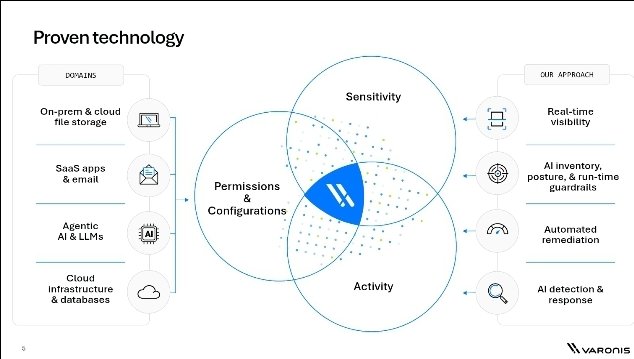
The strategic case the two companies make is unusually clean. Proofpoint, which it says reaches 3.4 million customers and scans 2.37 trillion emails a year, understands how attacks begin — with people, and increasingly with AI agents acting on their behalf. Varonis maps where sensitive data lives, who and what can reach it, and how it is used across cloud, SaaS, databases and on-premises systems. In the framing Proofpoint’s chief executive, Sumit Dhawan, offered, the data an AI system can access “determines both its value and its risk.”
The framing has a practical edge for buyers. Most large organisations now run AI assistants and agents across the same systems that hold their most sensitive information, and few can say with confidence what data those agents can reach. Joining an email-and-people security platform to a data-mapping platform is, in effect, an attempt to answer that question end to end. Whether a single vendor can do it better than two well-integrated ones is the open question every cybersecurity acquisition of this kind raises. Put together, the companies argue, those capabilities produce a platform that can connect communications, identities, permissions, data and AI — finding and protecting sensitive data, controlling what people and AI can access, and stopping data loss.
That is the pitch behind what they describe as the industry’s largest data and AI security organisation, serving more than 16,000 enterprises. The logic is coherent, and it reflects a real shift: as AI agents take autonomous action across enterprise systems, the questions of what data they can reach and what they do with it have become pressing in a way they were not two years ago.
The consolidation wave
The deal is the largest in a run of AI-driven consolidation in cybersecurity. The Wall Street Journal framed it as AI security continuing to drive deals and investment across the sector, and Bloomberg Law placed it against a rebound in technology M&A. Consolidation is the industry’s response to a familiar problem: security teams juggling dozens of tools, and vendors arguing that a platform is easier to buy, run and defend than a stack of point products. Proofpoint’s own messaging leans into that — “fewer vendors,” as Varonis put it, and an opportunity to “simplify the security stack, consolidate vendors, reduce operational complexity.”
Consolidation has a logic of its own in security. Buyers have tired of assembling point tools and of the integration work each one demands, and platform vendors have responded by acquiring the capabilities they lack. This cybersecurity acquisition fits that pattern: Proofpoint already owned the human-facing layer — email, collaboration, data-loss prevention — and Varonis supplies the data-facing layer. The risk is that platform breadth becomes a reason to buy rather than a reason the product works better. The buyer has been assembling that platform for years. Thoma Bravo took Proofpoint private in 2021 for about $12.3 billion, and the company’s annual recurring revenue reached roughly $2.45 billion by the end of 2025.
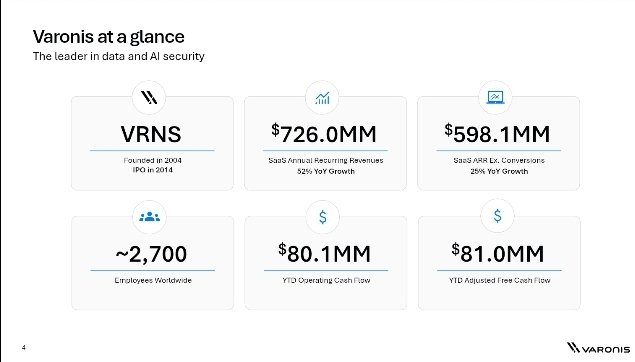
Less than a year before this deal, Proofpoint acquired Hornetsecurity for $1.8 billion. The seller, meanwhile, had been building in the same direction: Varonis, founded in 2004 and employing about 2,800 people — roughly 1,000 of them at a Herzliya development centre in Israel — launched Varonis Atlas in 2026 to monitor AI systems and agents, and bought AllTrue.ai for $150 million, after earlier acquisitions including Cyral and SlashNext.
The caveats
Three things temper the story. First, the premium is flattering but flattering from a low base: the 52% figure measures against a June close that preceded the sale rumours, and Varonis’ stock had fallen sharply earlier in 2026 after an earnings miss, which is part of why it was available. Second, the deal is debt- and equity-funded by a private-equity owner, which is normal for Thoma Bravo but means the combined company carries the leverage and expectations that come with it; Varonis’ own materials note the potential for “a future return to the public markets,” the classic PE arc.
Third, the synergy case is prospective. The claim of being the industry’s largest data and AI security organisation is the companies’, and integration — always the hard part of M&A — has not begun; until the deal closes, the two will operate separately.
There is also the question of what the seller gets. Varonis’ leadership describes the deal as delivering immediate, certain value above its standalone plan — a fair description of an all-cash exit at a premium, and also the standard rationale for selling. For a company that had been investing in AI security and had just acquired AllTrue.ai, the decision to sell rather than press on alone is itself a signal about how competitive the standalone path looked.
One more factor deserves attention: regulatory timing. A combination of two significant data-security vendors will draw antitrust scrutiny in the US and abroad, and the filing lists foreign clearances among its conditions. For a cybersecurity acquisition of this scale, the approval calendar is not a formality; it shapes how quickly the integration can even begin, and how long customers wait for the platform the deal promises.
What to watch
For CISOs, the practical question is whether this cybersecurity acquisition simplifies their stack or narrows their choices. Consolidation can mean fewer contracts and less integration work; it can also mean a larger bill and less leverage. Which one this becomes depends on the integration roadmap the companies have not yet published, and on whether the combined platform is genuinely more than two products sold together. Three things will show whether the deal delivers. First, whether the companies publish a concrete integration roadmap and combined financials, which would let investors judge the synergy case rather than take it on description.
Second, whether regulators clear it on schedule, given the antitrust and foreign-approval conditions in the filing. Third, whether customers reward consolidation or resist it: enterprise security buyers have spent years hearing that they should reduce vendor sprawl, but they also worry about lock-in, and the answer will shape whether this deal is a template or a cautionary tale.
What the deal does and doesn’t establish
It establishes an all-cash acquisition at $49.75 a share, a $6.3 billion transaction value, a unanimous board approval, a first-half-2027 closing target, and a financing structure backed by Thoma Bravo and the Ontario Teachers’ Pension Plan. It does not establish that the integration will succeed, that the combined platform will be the largest of its kind, or that the synergies the companies describe will materialise.
The honest summary is that this is a well-reasoned bet on where cybersecurity is heading. As AI agents become autonomous participants in the enterprise, the data they touch becomes both the asset to protect and the risk to manage, and a vendor that understands what attackers target is a logical partner for one that understands how they get in. The logic is sound and the price is real. But a coherent strategy is not a completed integration, and this cybersecurity acquisition will prove its value not on the announcement but over the two years it takes to make two platforms into one. For the industry, the signal is that data and AI security has become the centre of gravity, and that private-equity owners will pay to consolidate around it. For buyers, it is a reminder to read the roadmap, not the announcement, before deciding whether consolidation helps them.
Editor’s Note: This article draws on the Proofpoint/Varonis release, Varonis’ Form 8-K on the merger agreement, and independent coverage by the Wall Street Journal, Bloomberg Law, Reuters/CNA, CRN, Ynet and Calcalist/CTech, plus the companies’ published materials. Deal terms are from the merger announcement and filing; the strategic and scale claims are the companies’. No interview was conducted.