
Global skills mobility: India gets a 17-member industry alliance
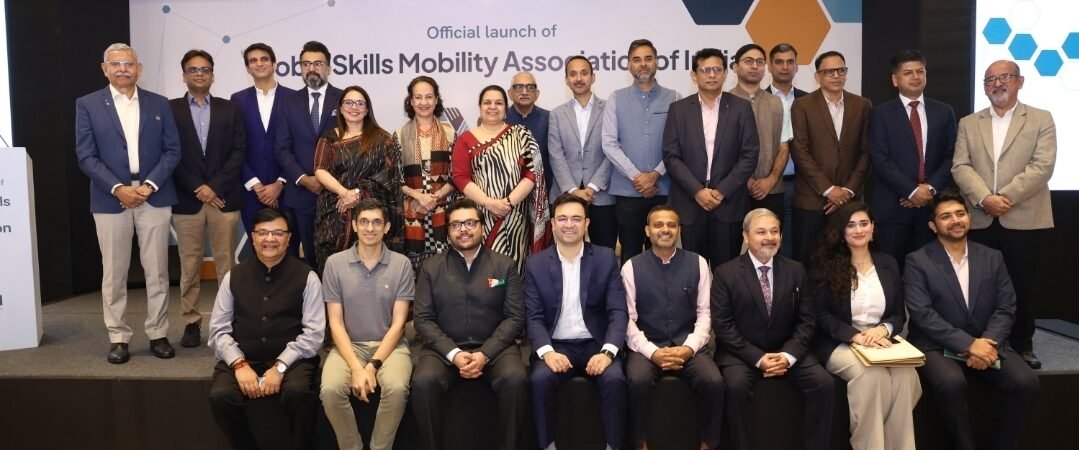
The Global Skills Mobility Association of India (GSMAI) launched in New Delhi on 12 October 2026, bringing together 17 founding organisations across recruitment, skilling, language training and employer engagement. Established as a not-for-profit Section 8 company limited by guarantee, the association aims to improve coordination across the systems that connect Indian talent with overseas employment. Its founding members span staffing and recruitment majors — Quess Corp, TeamLease, Adecco, Randstad India — alongside visa services firm VFS Global, skilling providers, and mobility specialists such as Magic Billion, BorderPlus and AnywhereJobs.
The global skills mobility coalition is notable for its breadth. It brings together staffing firms that place workers, recruiters that source them, a visa-services company that processes their paperwork, and skilling providers that train them — the full chain, in one body. That is the point: global skills mobility is a coordination problem, and the association’s bet is that the organisations in that chain can align faster than governments can legislate.
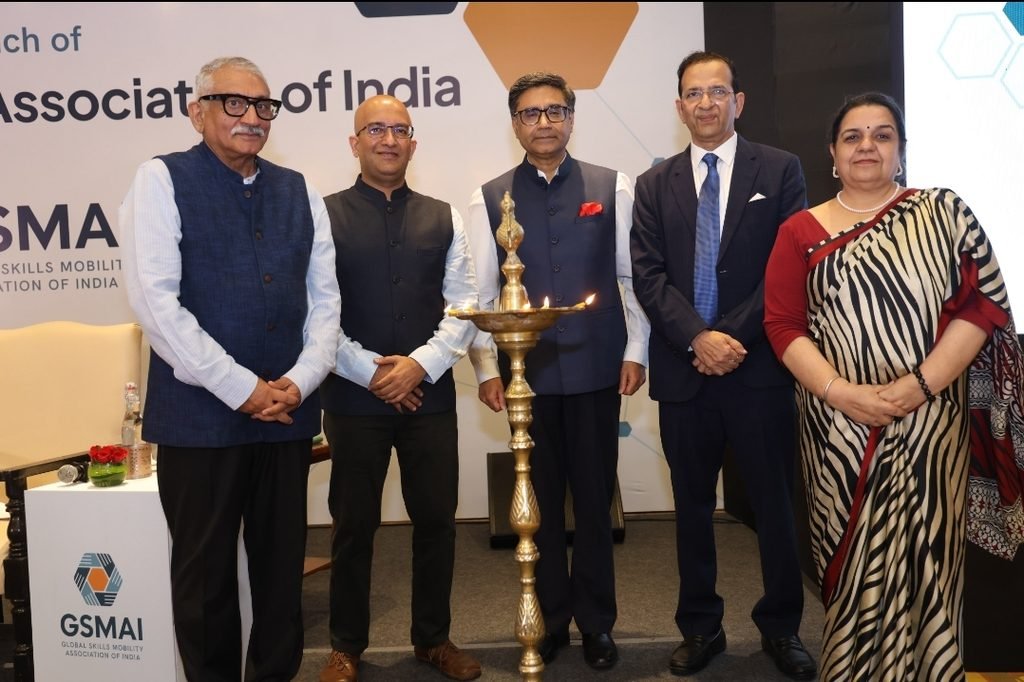
The Foreign Secretary, Vikram Misri, delivered the inaugural keynote and unveiled the association’s logo and website. The launch also featured a keynote from Shashank Mani, a Member of Parliament who chairs the Standing Committee on Labour, Textiles and Skill Development, and a diplomatic dialogue on talent corridors with representatives from the embassies of Germany, Italy, Denmark and Switzerland. Maharashtra and Odisha took part as state partners.
Why now: the demand abroad
The case for the alliance rests on demographics. Working-age populations in Japan, Germany and Italy are shrinking, while India’s workforce keeps growing. The release puts the contrast sharply: for every Indian aged 50 or above, India has about 1.4 people under 18 — roughly five times Japan’s ratio and about four times Germany’s.
The demand side is well documented even if that specific ratio is not. Germany needs about 288,000 foreign workers a year, according to a 2024 Bertelsmann Foundation study, or its workforce could shrink by 10% by 2040. Its Indian workforce grew from roughly 23,000 in 2015 to more than 136,000 in 2024, after Germany raised the skilled-visa quota for Indians from 20,000 to 90,000. Japan, whose population has fallen from about 128 million in 2008 to roughly 122 million and where nearly 30% of people are 65 or older, agreed with India on a two-way exchange of 500,000 people over five years, including 50,000 workers. The OECD projects Japan’s working-age population to fall to about 60% of its 2000 size by 2050.
Pull is not Only Demographic
The pull is not only demographic. Destination countries have made mobility easier in specific sectors: Germany’s visa quota increase, Japan’s Specified Skilled Worker route, and India’s own mobility agreements, several of which carry mutual-recognition annexes for skills. What has lagged is the machinery that makes those pathways trustworthy — language readiness, verified qualifications and recruitment that does not exploit the worker. The scale is large. India received about $137.67 billion in remittances in 2024, a figure NITI Aayog cites as evidence of the opportunity — and of the dependency.
Mobility is not a side channel for India’s workforce; it is a structural part of its employment and skilling architecture. That is the opportunity. “There is almost a need for 65 to 70 million people globally, and India has a surplus of professionals of the 40 million variety,” Mani said at the launch. Those figures are a speaker’s estimate rather than a sourced statistic, but the direction is not in dispute.
The gaps the alliance targets
Recruitment, skilling, language training and employer engagement have long run in separate lanes, and the alliance’s premise is that coordinating them makes mobility safer and more effective. Its stated priorities are ethical recruitment, market intelligence, a collective industry voice, and connecting recruiters, employers, training providers and governments.
Those are the right targets, because the gaps are real. NITI Aayog’s 2026 “States’ Framework on International Mobility” calls for circular mobility, state-run recruitment systems, foreign-language training and digital migration dashboards, and the Ministry of External Affairs is working on an Overseas Mobility (Facilitation and Welfare) Bill that would create an Overseas Mobility and Welfare Council. On the recruitment side, the MEA’s eMigrate platform has published a list of 3,505 unregistered agents that drew grievances — a reminder of why ethical recruitment is the industry’s central reputational risk. The industry’s reputation is the stake. Recruitment fraud — overcharging, contract substitution and misleading job offers — is exactly what the government’s proposed Overseas Mobility Bill and NITI Aayog’s framework aim to curb, and it is the reason an industry body’s promise of ethical recruitment carries weight only if it is enforceable among its own members.
The state dimension is the other half. NITI Aayog’s framework assigns states an operational role — developing workforce preparation, managing mobilisation and facilitating placement — and the alliance’s partnerships with Maharashtra and Odisha reflect that. Skilling happens locally; demand is global; the bridge between them is where coordination either works or fails.
The recognition bottleneck
If there is a single hard problem behind the launch, it is not finding workers or employers — it is getting qualifications recognised across borders. The European Union estimates that recognising a third-country qualification for a regulated profession takes about 14.2 months on average, at a direct administrative cost of roughly €1,500 per application. It has proposed a “Skills Portability Act” and a directive on third-country qualifications to bring that down to about four months, with qualifications issued as verifiable digital credentials.
The delay is not bureaucratic trivia; it is the difference between a worker taking a job and a worker taking a worse one. A nurse or a welder whose qualification is not recognised quickly cannot practise at their skill level, and the months spent waiting are months of lost earnings — for the worker and, in remittances, for India.
Digital Credentialisation Matters
That is where digital credentialisation matters. The International Labour Organization has built a regional Skills Passport in Latin America and the Caribbean that uses verifiable digital credentials — checkable by QR code — to enable mutual recognition of skills certifications across borders, with 100,000 credentials targeted for verification between 2026 and 2027. Sri Lanka and Pakistan run national skills passports on similar principles, largely to help returning migrant workers prove what they learned abroad. The lesson from those efforts is that credentialisation is an infrastructure problem, not a paperwork one. A skills passport works only if the issuing institution is trusted, the credential is verifiable in seconds, and the receiving employer or regulator accepts it.
That is why the EU is moving to standardised digital formats, and why the ILO built its passport on verifiable credentials rather than certificates. For India’s global skills mobility ambitions, the same logic applies: the value of a credential is set by the country that accepts it. At the launch, TeamLease chief executive Neeti Sharma made the point directly: ethical circular mobility “has to be digitally credentialised.”
For India, that is the practical frontier. Skilling programmes such as the Skill India International Centres already train workers to foreign occupational standards, and India has concluded more than 20 migration and mobility agreements, several with mutual-recognition annexes. But a certificate that a destination country cannot verify quickly is worth little, and an industry body that can standardise how Indian skills get credentialed and recognised would address a gap that individual recruiters cannot.
What to watch
For GSMAI, the test is whether it becomes an operational body or a talking shop: whether it publishes market intelligence, sets standards for ethical recruitment, and gives the industry’s members a way to credential skills that employers abroad accept. For workers, the benefit depends on whether coordination reduces the fees, fraud and contract substitution that make mobility risky. And, or the government, the alliance is a private-sector counterpart to the Overseas Mobility Bill — useful if it can move faster than legislation, and a source of pressure if it cannot. The next signals will be a work plan, a membership model and, most tellingly, whether the alliance’s members adopt a shared standard for verifying skills.
For the wider mobility market, the launch matters less for what it promises than for what it signals: that the industry sees coordination and credentialisation as its own problem, not only the government’s. If the association can make Indian skills verifiable abroad, it will have advanced global skills mobility in a way no individual recruiter could.
What the announcement does and doesn’t establish
It establishes an association, its founding members, its structure as a Section 8 company, and its broad priorities. It does not establish funding, a work plan, targets or any deliverable, and it does not substantiate the demographic ratio or the speaker estimates quoted at the launch. The coalition’s membership is real and significant; its effect is not yet measurable.
The honest summary is that India’s global skills mobility industry has organised itself into a single body at a moment of real opportunity and real risk. The demographic and demand arguments are sound, and the coordination it proposes addresses genuine gaps. Whether it changes anything depends on the least glamorous part of the problem: making Indian skills verifiable, and making recruitment ethical.