
Trinity Cleantech Private Limited showcased a new approach to electric mobility at the India Energy Summit & Expo 2026 in Hyderabad. The company presented technologies designed to address two critical challenges in India’s energy transition: expanding charging infrastructure and strengthening power availability.
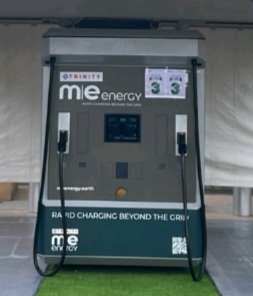
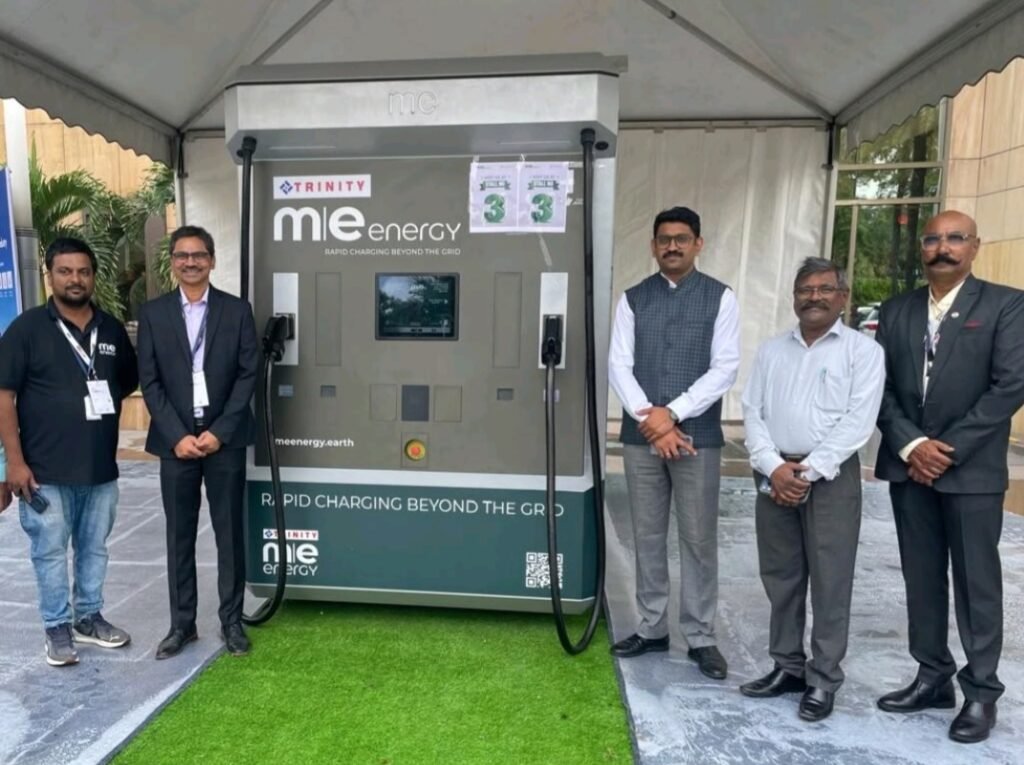
The centrepiece was its ME Energy Rapid Charger 150, a 150 kW DC fast charger that generates electricity on site using liquid bioethanol. The technology enables EV charging without relying on a conventional grid connection.
Alongside the charger, Trinity showcased Package Substations and its transformer portfolio. Together, the solutions demonstrate the company’s broader strategy of connecting established electrical engineering with clean mobility, distributed power and energy resilience.
From grid-connected to grid-independent charging
India’s EV ecosystem is expanding rapidly, but charging infrastructure remains dependent on the availability of suitable electrical connections. High-power charging sites can require significant grid capacity, electrical infrastructure and connection timelines.
Trinity’s bioethanol-powered EV charging technology addresses a different part of this challenge.
The ME Energy Rapid Charger 150 combines an onboard bioethanol-fuelled power-generation system with power-conversion electronics, an energy buffer and dual CCS2 charging interfaces. It can deliver up to 150 kW of DC charging output.
The system can support one charging session at full output or distribute charging capacity across two simultaneous CCS2 sessions, depending on operating conditions and configuration.
The technology is aimed at locations where grid expansion may be difficult, delayed or commercially challenging. Potential applications include highways, fleet and bus depots, mining and industrial sites, defence locations, rural hubs, construction sites and emergency-response operations.
Other potential applications include ports, airports, railway maintenance facilities and renewable-energy parks.
ME Energy brings charging beyond the conventional grid
The ME Energy technology was originally developed in Germany. Trinity’s strategic plans state that it completed a 100% acquisition of me Energy, including a portfolio of 17 patents.
The company is consolidating product development and manufacturing at its more than 20-acre facility at Jadcherla Green Industrial Park in Telangana.
This gives the technology an additional significance for India’s manufacturing ecosystem. An internationally developed charging platform is now being brought under Indian ownership, with manufacturing and further development taking place in Telangana.
Trinity describes the proposition as bioethanol-powered EV charging beyond the grid. The approach could be particularly relevant for applications where installing new high-capacity grid infrastructure is impractical.
The Rapid Charger 150 also attracted national attention earlier this month. On August 2, Union Minister for Coal and Mines G. Kishan Reddy participated in the inauguration of ethanol-based mobile EV charging technology in Hyderabad.
The technology’s potential to support green mobility, increase ethanol utilisation and reduce petroleum dependence was highlighted during the event.
Package Substations support connected EV infrastructure
Trinity’s exhibition presence was not limited to off-grid charging.
The company also showcased its Package Substation and Compact Substation platforms, covering capacities from 250 kVA to 2500 kVA and system voltages of 11 kV, 22 kV and 33 kV.
These factory-engineered systems can integrate transformers, high-voltage switching equipment, low-voltage switchgear, protection systems and energy metering.
The platforms are also designed for digital integration. Depending on configuration, they can support SCADA and EMS applications, remote monitoring and IoT connectivity.
Communication options include Modbus RTU, Modbus TCP, IEC 61850 and IEC 60870-5-104.
This makes the platform relevant to high-power EV charging installations that remain connected to the electrical grid.
A grid-connected charging station needs more than the charger itself. It also requires dependable medium-voltage transformation, switching, protection, distribution and metering.
Trinity therefore sees its Package Substations as the electrical infrastructure supporting conventional high-power charging.
One company, two charging architectures
The combination of the two technologies creates an interesting proposition.
Where sufficient grid capacity is available, a Trinity Package or Compact Substation can provide the electrical infrastructure required for connected charging.
Where grid access presents a constraint, the ME Energy platform can provide bioethanol-powered EV charging without requiring a conventional grid connection.
This gives Trinity the ability to address different infrastructure scenarios rather than relying on a single charging architecture.
The distinction could become increasingly important as EV adoption expands beyond major urban centres.
Highways, logistics corridors, mining operations, industrial facilities and remote infrastructure projects may not always have immediate access to the electrical capacity required for high-power charging.
Transformers remain the engineering foundation
The company’s clean-energy ambitions build on a longer electrical engineering legacy.
Trinity’s transformer portfolio includes distribution transformers from 25 kVA to 2500 kVA, power transformers from 3.15 MVA to 12.5 MVA and inverter-duty transformers from 500 kVA to 10 MVA.
The portfolio includes different core, winding, insulation and voltage configurations depending on application requirements.
At the Hyderabad exhibition, however, the most significant transformer message was not a specification.
Several visitors recognised the Trinity brand from transformers supplied during earlier years of the company’s operations. Some equipment had been delivered between 2013 and 2022.
That recognition was particularly significant for Trinity because it was based on field experience rather than current marketing activity.
It also reinforces the importance of reliability in electrical infrastructure. Transformers can remain operational for many years, making product quality an important part of long-term brand credibility.
Moving from electrical equipment to energy infrastructure
Trinity views its product portfolio as an interconnected platform.
Transformers provide the electrical foundation. Package Substations turn that foundation into integrated power systems. ME Energy extends the company’s charging proposition into locations where conventional grid infrastructure may not be readily available.
The company is also developing additional ME Energy products.
Its roadmap includes an 80 kW variant and a combined Generator + EV Charger platform. The latter is intended to provide electrical power and EV charging from a single mobile asset.
Potential applications include disaster response, defence field operations, construction and other critical infrastructure requirements.
Such applications illustrate how EV charging can increasingly become part of a broader distributed-energy strategy rather than simply a roadside service.
Telangana manufacturing supports the next phase
Trinity’s manufacturing plans add another dimension to the company’s strategy.
The company operates a more than 20-acre manufacturing facility at Jadcherla Green Industrial Park in Telangana. It is consolidating ME Energy product development and manufacturing at the facility following its acquisition of the German-origin technology.
The approach aligns clean mobility technology with India’s broader manufacturing ambitions.
It also positions Telangana as a base from which Trinity can target both domestic and international markets.
The company has indicated that international exports are part of its later-2026 plans.
Industry recognition at India Energy Summit & Expo
The sixth edition of the India Energy Summit & Expo took place in Hyderabad on August 18–19, bringing together policymakers, utilities, technology companies, investors and energy-sector leaders.
Senior visitors to Trinity’s pavilion included Telangana Deputy Chief Minister and Minister for Finance & Planning Bhatti Vikramarka Mallu, Telangana Special Chief Secretary for Energy Naveen Mittal, TGSPDCL Chairman and Managing Director Jitesh V. Patil and APEPDCL Director (Projects) T. Vanaja.
The exhibition also provided Trinity with an opportunity to demonstrate how its established transformer business connects with emerging energy technologies.
Raj Kumar Medimi, Executive Director, Trinity Cleantech Private Limited, said the response to the company’s technologies was particularly meaningful because visitors recognised both its new solutions and its earlier transformer installations.
He described the company’s direction as taking its engineering legacy into the next generation by combining electrical infrastructure with grid-independent EV charging and clean-energy technologies manufactured in Telangana.
Building resilient energy infrastructure
The transition to electric mobility will require more than an increase in the number of EV chargers.
It will require reliable power infrastructure, flexible charging architectures and solutions capable of operating across different geographic and grid conditions.
Trinity’s strategy addresses these requirements through a combination of transformers, intelligent Package Substations and bioethanol-powered EV charging.
The approach also reflects a broader shift in the energy sector. Future charging networks may combine conventional grid connections with distributed generation and mobile power solutions.
For India, that flexibility could become increasingly important as EV adoption expands across cities, highways, industrial corridors and remote locations.
Trinity’s participation at India Energy Summit & Expo 2026 therefore represents more than a product showcase. It signals the company’s ambition to evolve from an established electrical equipment manufacturer into a broader clean-energy infrastructure player, with Telangana as its manufacturing base.
About Trinity Cleantech Private Limited
Trinity Cleantech Private Limited is an Indian manufacturer of transformers, packaged substations and EV charging infrastructure.
The company’s portfolio includes distribution, power and inverter-duty transformers, Package and Compact Substations, and ME Energy off-grid EV charging technology.
The ME Energy platform originated in Germany and is now under Trinity ownership. Product development and manufacturing are being consolidated at Trinity’s facility in Telangana, with the company targeting Indian and international clean-energy markets.