
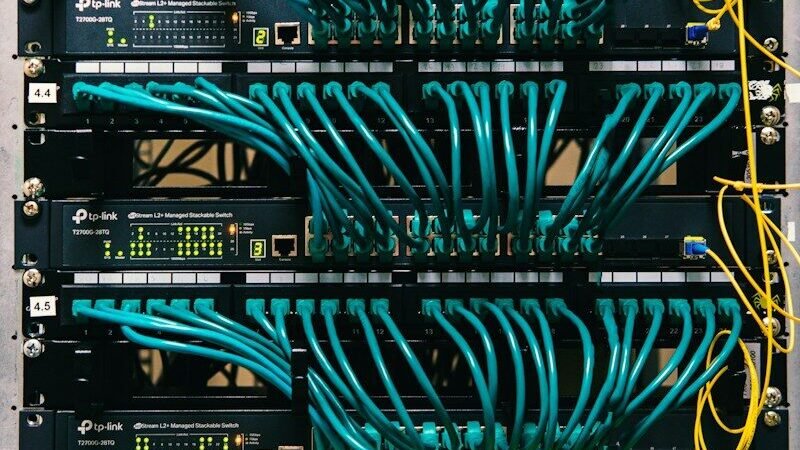
HPE used its Networking Investor Day on 30 September to raise its outlook. It also planted a flag in the most contested part of AI infrastructure. The company lifted its fiscal 2027 Networking revenue growth outlook to between high teens and low-20s percent. It also disclosed a $1.2 billion order from the cloud provider Vultr, for AMD Helios AI Rack by HPE systems.
The headline is the growth target. The more revealing detail is what HPE puts inside the rack.
The targets on the table
HPE is asking investors to believe networking is where the AI-era margin lives. The numbers are specific.
For fiscal 2027, the Networking segment is guided to high-teens to low-20s percent revenue growth, at a mid-to-high 20s percent operating margin. Over the longer term, HPE projects high-teens percent revenue CAGR from FY26 through FY29, holding that margin band.
The category targets through fiscal 2029 are sharper. Data Center Networking is projected to grow at a low-to-high 50s percent CAGR. Routing sits at low-to-high 20s percent. Campus & Branch and Security are each at high single-digit percent.
HPE also raised its Juniper cost-synergy target to $800 million in annual run-rate savings by the end of fiscal 2028, up from at least $600 million. The original target, at the deal’s 2025 close, was at least $450 million.
That is a company that has decided its future is networking-led.
What Juniper actually bought
The acquisition is the foundation of the whole thesis, and it was hard-won. HPE announced the Juniper deal in January 2024 at about a $14 billion equity value. It closed on 2 July 2025, for aggregate consideration of roughly $13.4 billion. The transaction doubled the size of HPE’s networking business. The new segment now represents more than half of HPE’s total operating income.
It did not close cleanly. To settle the US Department of Justice’s challenge, HPE agreed to divest its Instant On campus and branch business. It also agreed to auction a perpetual, non-exclusive licence of Juniper’s Mist AIOps source code. Former Juniper CEO Rami Rahim now leads the combined business.
The synergy ladder tells its own story: $450 million promised in 2025, raised to $600 million, now $800 million. Each step up is a claim that the integration is running ahead of plan. Investors will want the third step to hold.
The Vultr order and the scale-up bet
The $1.2 billion Vultr order is HPE’s first for the AMD Helios system. It is the most concrete thing in the release. Vultr will deploy the racks at US cloud data-centre locations for training and inference workloads.
The specification is the interesting part. Each rack carries 72 AMD Instinct MI455X GPUs, AMD EPYC “Venice” CPUs, Pensando Vulcano AI NICs and the ROCm software stack. Six HPE Juniper Networking QFX5252 scale-up Ethernet switch trays per rack connect all 72 GPUs over standards-based Ethernet, supporting UALink over Ethernet. HPE supplies direct liquid cooling and deployment services.
That last detail is the strategy in miniature. Historically, HPE’s networking sat in the scale-out fabric between racks, or in the routing layer between clusters. With six switch trays inside the rack, HPE Juniper moves into the scale-up domain. That is the tightly coupled GPU-to-GPU interconnect proprietary fabrics have owned.
AMD’s pitch is that Ethernet, with UALink, can carry that load. AMD claims up to 2.9 exaflops of FP4 compute and 31 TB of HBM4 per rack. It says that is about 50% more HBM capacity than Nvidia’s Vera Rubin NVL72.
Rahim told investors that Helios represents “more than a billion-dollar networking opportunity over the next two years.” Networking tray orders already exceed $200 million.
Why scale-up is the real story
The Data Center Networking target is the most aggressive number HPE put on the table: a low-to-high 50s percent CAGR. It only makes sense if HPE is counting the scale-up domain, not just the conventional scale-out switch market it already serves.
That reframes the competition. HPE’s scale-up entry pits open Ethernet and UALink against Nvidia’s integrated stack of NVLink, proprietary networking and CUDA. Nvidia’s counter is integration: accelerators, interconnect, networking and software designed as one system, with a software community that is hard to match.
Vultr’s position is instructive. It did not replace Nvidia with AMD. In June 2026 it chose HPE and Nvidia for GB300 NVL72 systems with Spectrum-X networking. The AMD order adds parallel capacity. Vultr is building around both ecosystems, which turns its data centres into a live comparison between the two.
That is exactly the test HPE needs. It does not have to beat Nvidia to win. It has to be trusted with the servers, networking, cooling and services around whichever accelerator a customer chooses.
What could go wrong
Three things deserve scrutiny.
First, the disclosure gap. HPE published a complete bill of materials for one rack and a total order value. It did not publish the number that connects them. No rack count, no total GPU count, no delivery schedule, no per-rack price.
The $1.2 billion is a procurement fact, not a capacity fact. Treating it as a capacity figure would overstate what has actually been committed.
Second, the framework caveat. HPE told investors in September that AMD Helios was not included in its existing FY27 Networking growth framework. So the scale-up story that underpins the Data Center Networking target is, for now, outside the guided numbers. That is honest, but it means the target rests on a business not yet in the forecast.
Third, competition. Cisco remains the incumbent HPE names first, and Arista owns much of the high-end data-centre switching that HPE wants. A 50s percent CAGR assumes HPE takes shares from both while Nvidia defends its integrated stack.
What to watch
Three markers will show whether the thesis holds. A disclosed rack count and delivery schedule for the Vultr order. The first independent evidence that an Ethernet-based scale-up fabric performs in production against InfiniBand. And whether the mid-to-high 20s margin survives a mix that leans further into integrated racks with third-party silicon.
HPE has assembled the pieces: a doubled networking business, a proven AI-operations platform in Mist, and now a switch position inside the GPU rack. The targets are bold and the first order is real. What is missing is the deployment data that would turn a bold forecast into a proven business.
Editor’s Note
Sources: HPE Networking Investor Day release of 30 September 2026 and its Form 8-K Exhibit 99.1, the investor-day transcript, HPE’s July 2025 press release and 8-K on closing the Juniper Networks acquisition, and the June 2025 DOJ settlement release. Coverage and analysis are from Reuters, CRN, SDxCentral, HPCwire, Converge Digest, Constellation Research, Techzine and FourWeekMBA. The category CAGRs, the $800 million synergy target, the AMD per-rack performance claims and the “billion-dollar networking opportunity” are company statements. The rack-count disclosure gap and the analysis of HPE’s scale-up positioning are TechRecast’s own.