
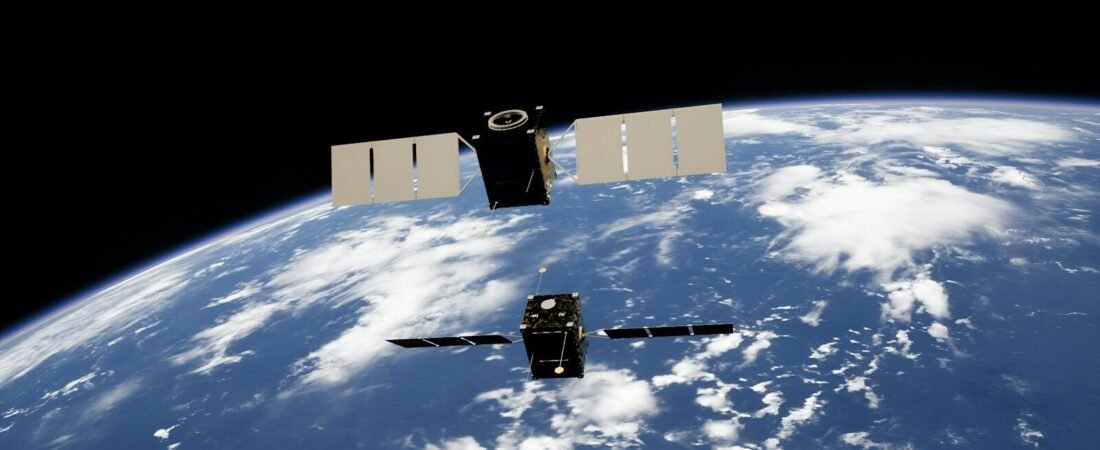
On the same SpaceX Transporter-18 rideshare flight, two satellites will test the same idea at wildly different scales. One is Google’s Project Suncatcher prototype: a refrigerator-sized spacecraft carrying four TPUs on about one kilowatt of solar power. The other is MOI-1A, a 14-kilogram CubeSat built by a Hyderabad startup called TakeMe2Space. It carries 117 TOPS of compute, 2TB of storage and a nine-band multispectral imager.
TakeMe2Space calls MOI-1A India’s first orbital computing satellite. The claim is fair in its narrow sense. It is also worth being precise about what MOI-1A is and is not.
What the satellite actually does
The idea is straightforward. Conventional Earth-observation satellites capture imagery, store it, and downlink it for processing on the ground. MOI-1A inverts that.
Customers upload containerised AI models to the spacecraft. When it passes over a chosen area, the models run inference against fresh imagery. They transmit the results — a detection, a classification, a measurement — instead of the raw files.
The hardware is commercial and terrestrial. The processor is an Nvidia Jetson Orin NX, an edge-AI chip used on the ground in robotics. TakeMe2Space wraps it in radiation shielding it calls RadShield and pairs it with 16GB of LPDDR5 memory and 2TB of storage. Founder and CEO Ronak Samantray puts the power budget at roughly 150 watts.
That number matters. Google’s prototype draws about a kilowatt for four chips. It can only run them in bursts of roughly fifteen minutes before the radiators need to catch up. MOI-1A, at 150 watts, is a small edge computer in orbit. It is not a data centre, and the company does not claim it is.
The target applications — agricultural monitoring, mining, supply-chain intelligence — are ones where a processed insight beats the underlying image.
The record behind the pitch
TakeMe2Space’s own history complicates the story, and deserves a straight account.
Its technology demonstrator, MOI-TD, launched aboard ISRO’s PSLV-C60 in December 2024 and completed 394 orbits. The company’s website describes it as “TRL 8: flight-proven and production-ready.” Reporting on the company’s own technical document tells a narrower story. The mission ran more than 20 experiments, but its two primary objectives — imaging and AI inference — were not achieved. Per that account, the AI experiment was halted by a software pipeline bug that prevented the hardware from being triggered.
Its next satellite, MOI-1, was lost on 12 January 2026 when the third stage of ISRO’s PSLV-C62 failed. MOI-1A is therefore the third attempt, and the company’s first operational mission.
The company says 23 customers are signed, including GIS companies and educational institutions. It has not named them. It also plans cold storage in orbit for financial-services and defence customers, and larger satellites from 2027.
Same rocket, opposite bets
The comparison with Google is instructive because the two payloads represent different theories of the market.
Google’s Project Suncatcher is a moonshot aimed at data-centre-scale compute in orbit. It relies on near-continuous sunlight in dawn-dusk sun-synchronous orbits, with satellites linked by high-bandwidth lasers. Its first test is deliberately modest: four Trillium TPUs, Gemini queries, fifteen-minute bursts. Google tested the chips in a proton beam at UC Davis and reports they survived more than a five-year mission’s radiation dose.
Starcloud has already flown further. It put an Nvidia H100 in orbit in November 2025, ran Gemini on it, and trained a small language model. It has raised $170 million at a $1.1 billion valuation.
SpaceX has filed for up to a million satellites at 100 kilowatts of compute per tonne. Axiom Space has placed data-centre nodes on the ISS and in LEO. Nvidia has announced a space-rated Vera Rubin module.
TakeMe2Space sits at the opposite end: one small satellite, commercial chips, a paying-customer model, and no pretence of gigawatt scale. Both bets can be right. The category needs the small experiments as much as the large ones, because the hard problems are identical at every size.
The economics nobody has solved
Cooling is the first. In a vacuum there is no airflow; heat leaves only through radiators. Google’s fifteen-minute duty cycle is a direct consequence — the chips must shut down before the radiators are overwhelmed. Radiation is the second: cosmic rays flip bits, and shielding costs mass.
Maintenance is the third, and the least tractable. A terrestrial data centre swaps failing accelerators in hours. In orbit, a failed chip stays failed.
The cost picture is unsettled. Google’s own paper puts the parity gate at launch costs near $200 per kilogram. A reusable Falcon 9 costs roughly $3,600 per kilogram today. Analyst models put orbital infrastructure at roughly $72 billion per gigawatt, against $16 billion off-grid — a 4.5x premium. Futurum estimates orbital compute could justify a $1 trillion market by 2030, but only if launch costs collapse.
TakeMe2Space’s model sidesteps some of this. At 14 kg, its launch cost is trivial beside a data-centre satellite. Its economics do not depend on reaching $200/kg. They depend on something simpler. Will a customer pay for an insight processed in orbit rather than an image processed on the ground?
What India is building
TakeMe2Space is not India’s only entrant. Pixxel leads the IN-SPACe-backed Allied Orbits consortium, which is building a 12-satellite national Earth-observation constellation worth over ₹1,200 crore. Pixxel has announced plans for what it calls India’s first orbital data centre satellite, powered by the Indian AI company Sarvam. Dhruva Space is building full-stack satellite and ground infrastructure. It holds a ₹105 crore government grant for a 500 kg platform aimed at high-volume manufacturing.
The pattern is consistent. India’s private space sector is moving from building satellites to building the intelligence layer on top of them. It is using rideshare launches, including SpaceX’s, to get there quickly. MOI-1A launching on Transporter-18 is part of that pragmatism: when your own rocket fails, you buy a seat on someone else’s.
What to watch
Three things will decide whether this becomes a business or a demonstration. First, whether the 23 customers convert to named, paying deployments with published results. Second, whether the company reconciles its “flight-proven” framing with its own technical record, because institutional buyers check. Third, whether in-orbit inference produces measurable savings against downlink — the only number that makes the model work.
The category is real and the engineering is honest. MOI-1A will not be a data centre in orbit. It will be a test of whether the smallest version of the idea can pay for itself.

Editor’s Note
Sources: TakeMe2Space’s press note, launch material and published satellite specifications; reporting by Reuters (via CNBC TV18 and The Next Web), India Today, SatNews, TwoKQ and Business Press. Also Google’s Project Suncatcher announcement and research blog, Reuters and Ars Technica coverage of the Suncatcher launch, Futurum Group’s orbital-compute analysis, Fierce Network and Data Center Dynamics reporting on the category, Orbital’s published plans, and Pixxel and Dhruva Space announcements. The “India’s first orbital computing satellite” claim, the TRL 8 status, the 23-customer figure and the RadShield description are company statements. Note that the discrepancy between the TRL 8 claim and the reported contents of the company’s technical document is flagged, not resolved. The analysis of the two theories of the orbital-compute market is TechRecast’s own.